Imagine doctors could understand exactly which cells caused a patient’s cancer or whether pathogens contributed to the disease. They could then use the information to tailor a treatment plan to the patient’s specific cancer. But answering such questions would mean wading through data from thousands of experiments locked in massive databases around the globe. Moreover, the search would take at least several days.
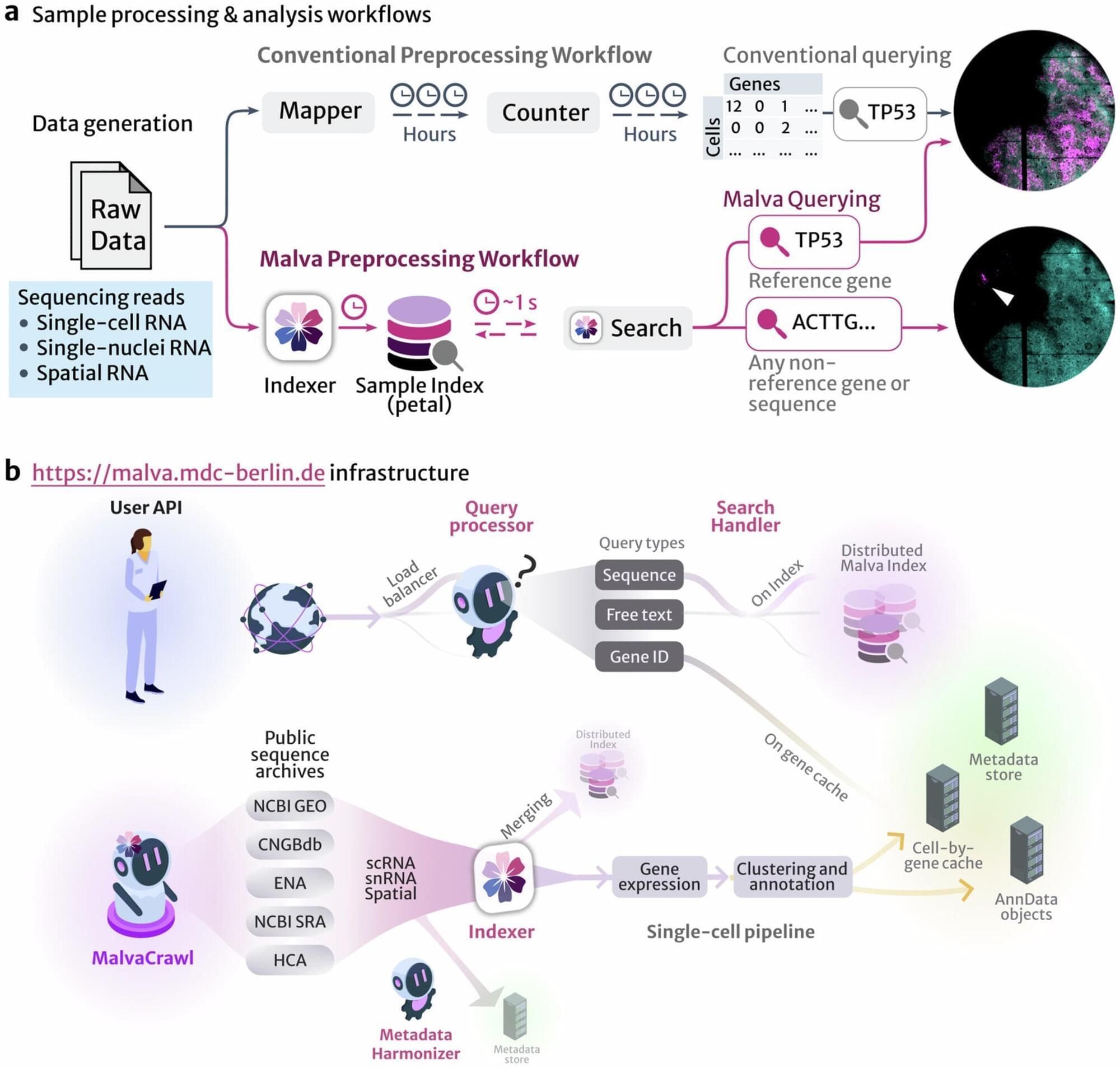
Now, researchers at the Berlin Institute of Medical Systems Biology of the Max Delbrück Center (MDC-BIMSB) present a search engine that radically simplifies such tasks: “Malva.” It is the first platform that can quickly sort through massive single-cell data using sequence information only, explains Daniel León-Periñán, first author of the study in Nature. León-Periñán is a doctoral student in the Systems Biology of Gene Regulatory Elements lab of Dr. Nikolaus Rajewsky, director of MDC-BIMSB.
“Like Google did for the internet 30 years ago, Malva allows scientists and AI tools to search across millions of cells in seconds—without downloading huge files, needing a reference genome or having deep computational expertise,” adds Rajewsky, senior author of the paper. “Malva transforms static transcriptomic atlases into dynamic resources, which will further our understanding of RNA biology. It could also be transformative in helping researchers understand how health slides into disease or how and which cells respond to specific medical treatments.”