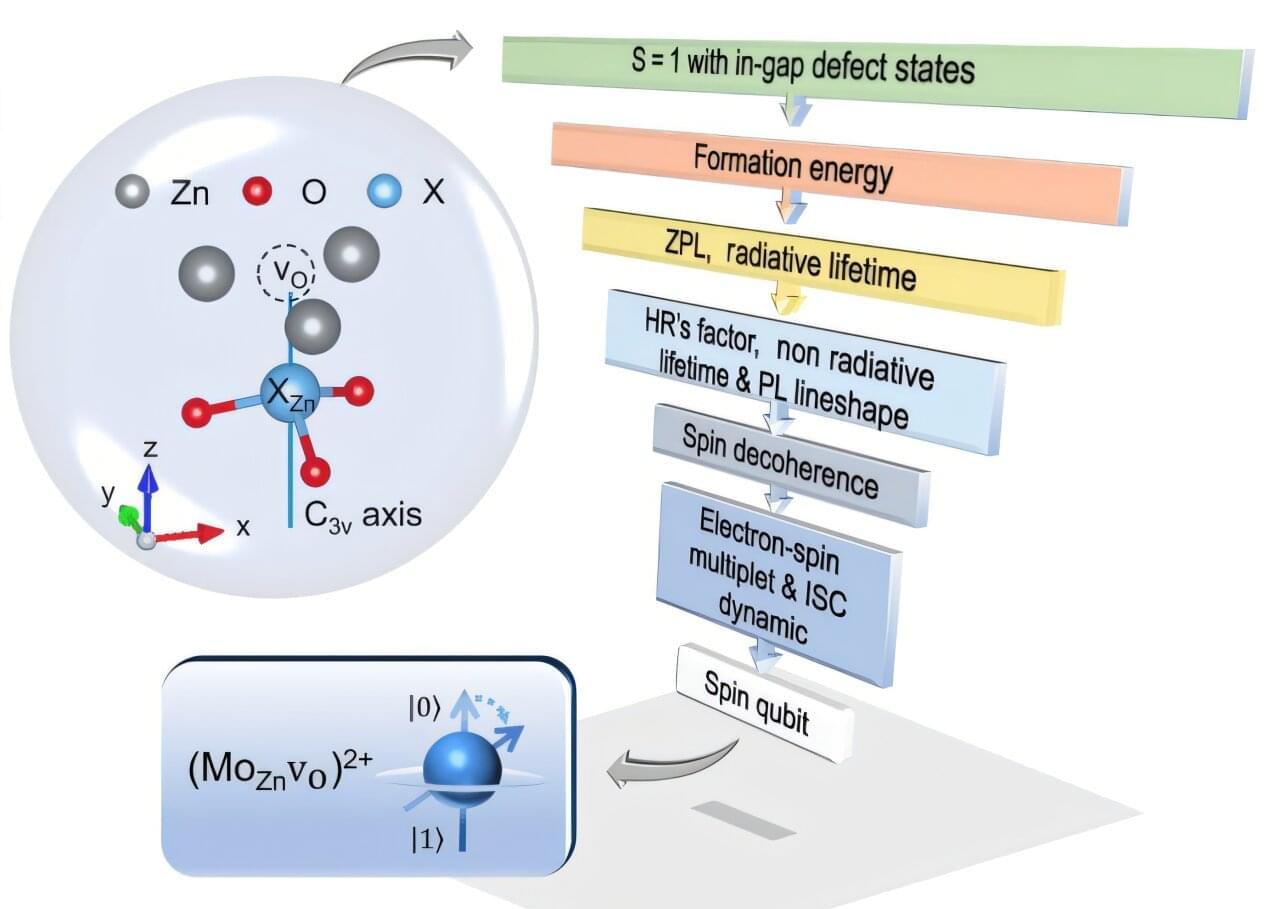
A research team led by SKKU professor Hosung Seo of the Department of Quantum Information Engineering and the SKKU Advanced Institute of Nanotechnology, working with the University of Wisconsin–Madison and the University of Washington, has identified—for the first time—an atomic defect structure in the zinc oxide (ZnO) semiconductor with outstanding properties for use as a “spin qubit,” a core building block of future quantum computers, quantum communications and quantum sensors.
The results are published in PRX Quantum.
Electron spins trapped at point defects in solid-state crystals can operate at room temperature and retain quantum information for long periods, making them a leading platform not only for quantum computing but also for quantum communications and ultrasensitive quantum sensing. The nitrogen-vacancy (NV) center in diamond has been the most prominent candidate, but diamond is difficult to grow into large-area, high-quality crystals and is poorly suited to standard semiconductor fabrication, posing major obstacles to the integration and mass production of quantum devices.