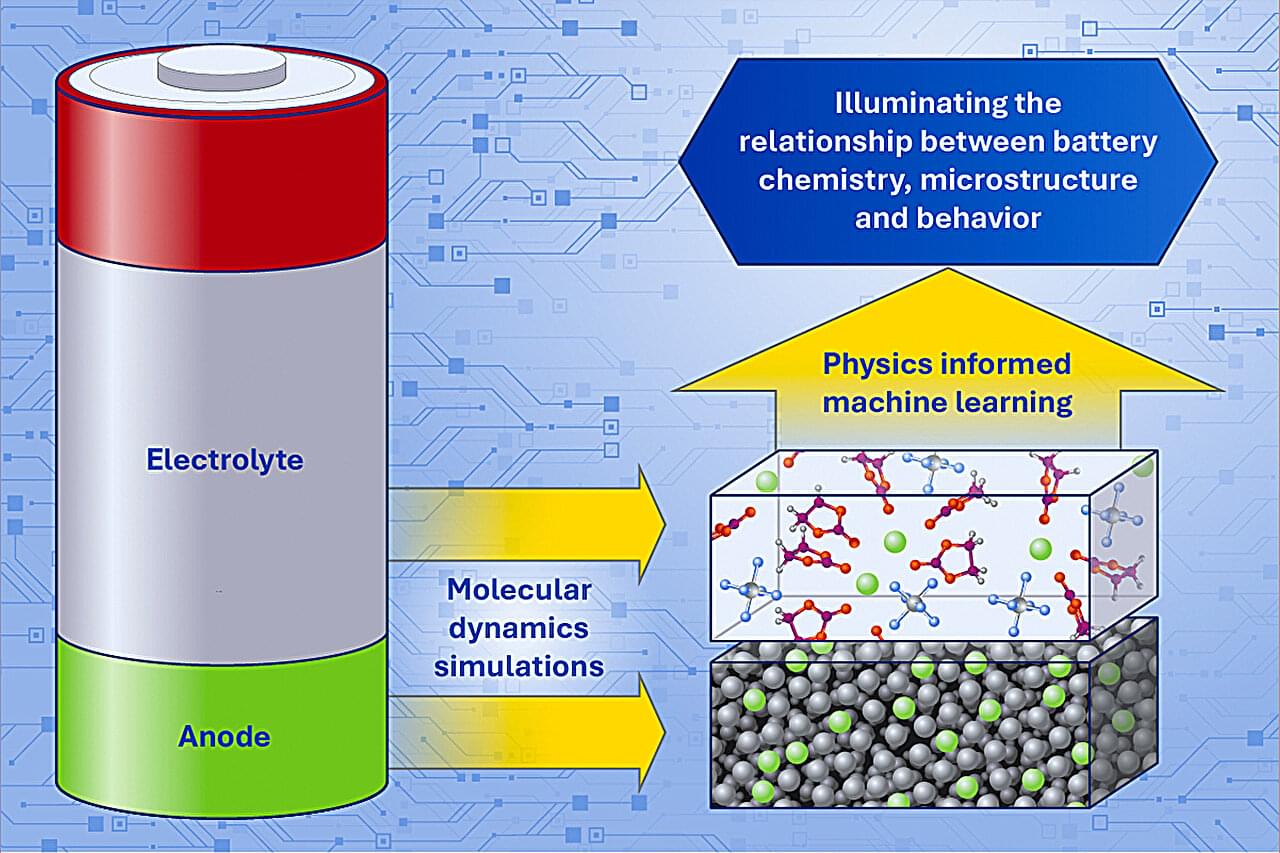
For grid-scale energy storage and national energy resilience, the U.S. needs better batteries. Lawrence Livermore National Laboratory (LLNL) scientists are tackling that challenge in many ways, but one approach is making a significant impact: physics-informed machine learning.
In two recent publications, LLNL researchers examined how integrating molecular dynamics simulations with physics-informed machine learning can illuminate the relationships between structure and behavior in complex battery materials. They used the combination of techniques to explore carbon anodes in sodium-ion batteries and liquid electrolytes in lithium-ion batteries.
“These studies show that the structural complexity of battery materials is not just an obstacle to understanding but a design advantage, laying the groundwork for high-throughput screening of next-generation energy-storage materials,” said LLNL scientist and author Liwen (Sabrina) Wan. “By encoding that complexity into physics-informed machine learning models, we can predict properties and identify design levers that traditional approaches simply cannot access.”