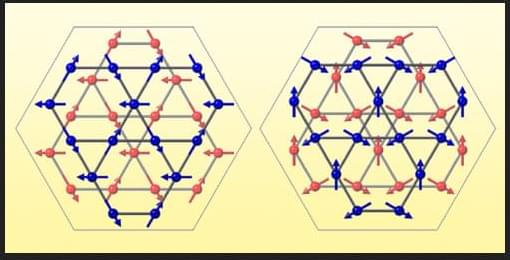
One of the goals of spintronics is to flip the magnetization of ferromagnetic domains solely via an electrically controlled spin current flowing in a layer underneath. The antiferromagnet manganese germanide (Mn3Ge) is a prime candidate for providing that control thanks to the out-of-plane polarization of its spin currents. Now Mingxing Wu of the University of Tokyo and his colleagues have identified which of two mechanisms proposed by theorists is responsible for the polarization [1]. The answer is both.
The triangular lattice of Mn3Ge causes groups of three adjacent spins to orient themselves at 120° with respect to each other. That noncolinear arrangement engenders so-called Weyl points in the crystal’s band structure. Thanks to a quantum geometry property called Berry curvature, Weyl points act like internal magnetic fields that deflect electrons in a spin-dependent way.
Until the work of Wu and his colleagues, just how the deflection leads to out-of-plane polarization was unclear. It could conceivably arise either via a mechanism called spin swapping (SSW) or via the magnetic spin Hall effect (MSHE). To settle the question, the researchers subjected single-crystal strips of Mn3Ge topped with layers of permalloy (a nickel–iron alloy) to a technique called spin-torque ferromagnetic resonance (ST-FMR). The ST-FMR signal from MSHE depends on the orientation of the Mn3Ge lattice with respect to the spin current, whereas the signal from SSW does not. By creating differently oriented samples, Wu and his colleagues found that both mechanisms contribute to the out-of-plane spin polarization with comparable magnitudes. Now that the mystery has been solved, the next step is to harness both mechanisms for the magnetic-field-free switching of magnetization.