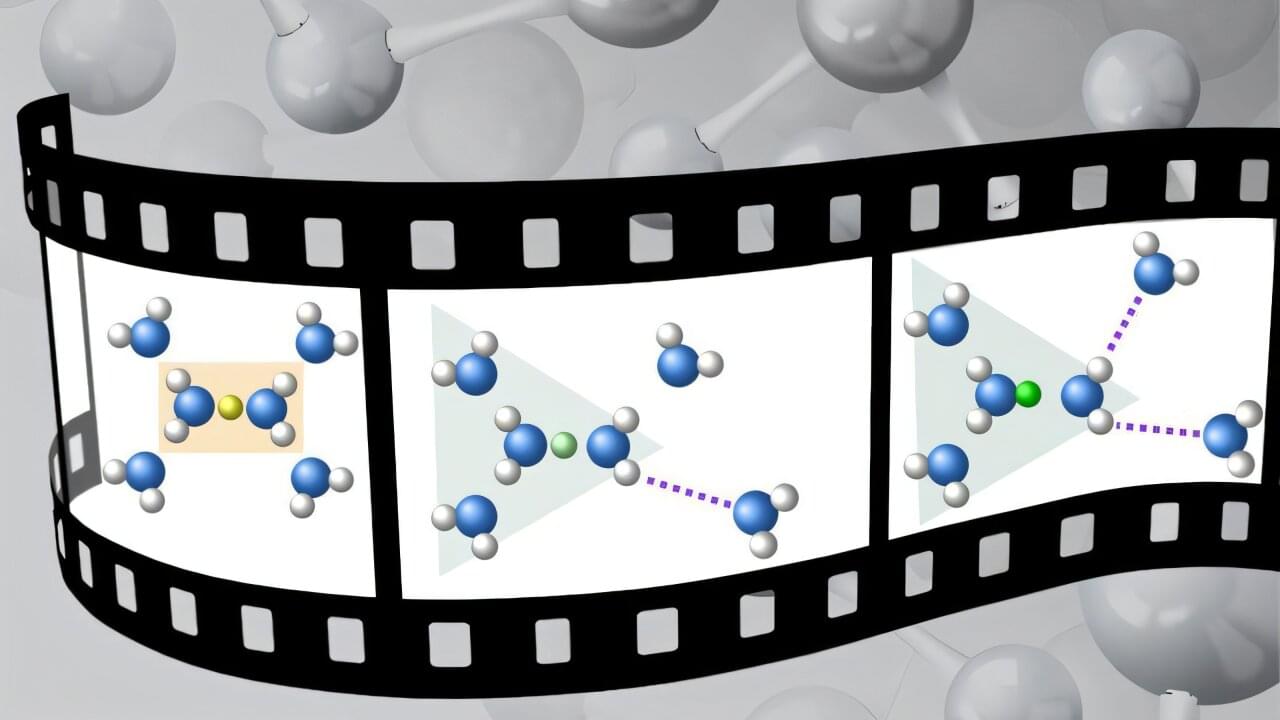
Complex simulations—the most intricate of their kind to date—carried out by an international research team led by scientists at Heidelberg University’s Institute for Physical Chemistry, have revealed how water governs the way protons move through it. Using their modeling, researchers from Cambridge (U.K.), Bochum, Dijon (France) and Heidelberg were able to trace, in full quantum detail, the movements of a proton shared among six water molecules. At its core, the work addresses how a proton moves through water: not as a single particle drifting along, but by “hopping” from one molecule to the next.
This “hopping” motion has been known since the 19th century. When an acid dissolves in water, the released proton—a positively charged hydrogen ion—does not remain bound to a single water molecule. It is highly mobile and constantly jumps from one molecule to the next.