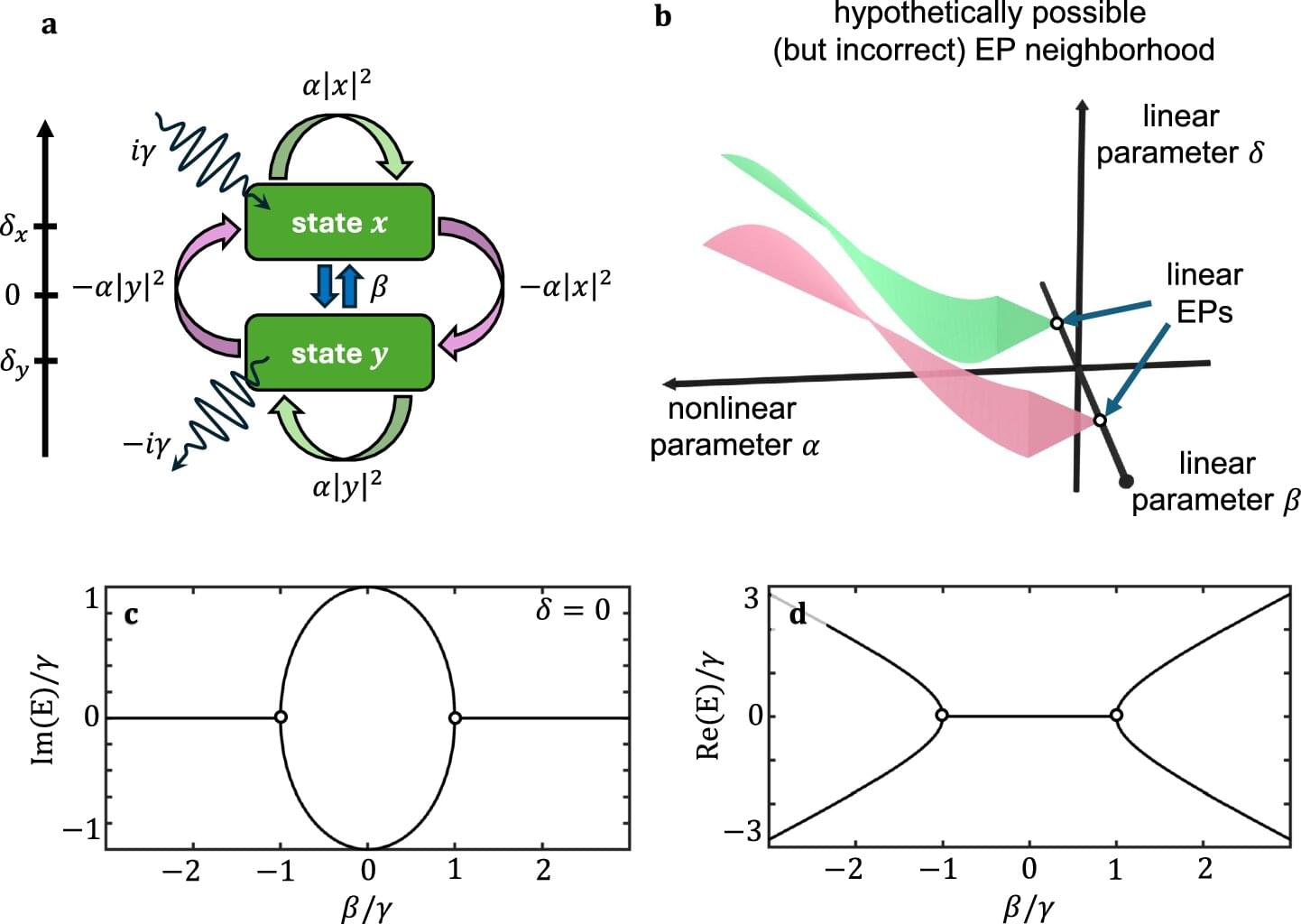
Exceptional points, or EPs for short, are among the phenomena of modern physics. These are special points or locations at which the properties of matter, space or time change. In a new theoretical study, researchers from the Institute for Photonic Quantum Systems (PhoQS) at Paderborn University, in collaboration with researchers from the University of Arizona, have shown that exceptional points in nonlinear systems follow a universal geometric order—something that was previously unclear. Their findings have been published in the journal Nature Communications.
Exceptional points are points in physical systems at which not only two eigenvalues but also the corresponding states merge. Such phenomena occur in so-called non-Hermitian systems, which are characterized, for example, by amplification, loss or interactions with their environment. They are the subject of intensive research in fields including optics, lasers, quantum systems and polariton condensates.
Until now, EPs have mainly been studied in linear systems. In such systems, they can often be described as isolated points in parameter space. However, many real physical systems are nonlinear: Their properties depend on the intensity, occupation or state of the system itself.