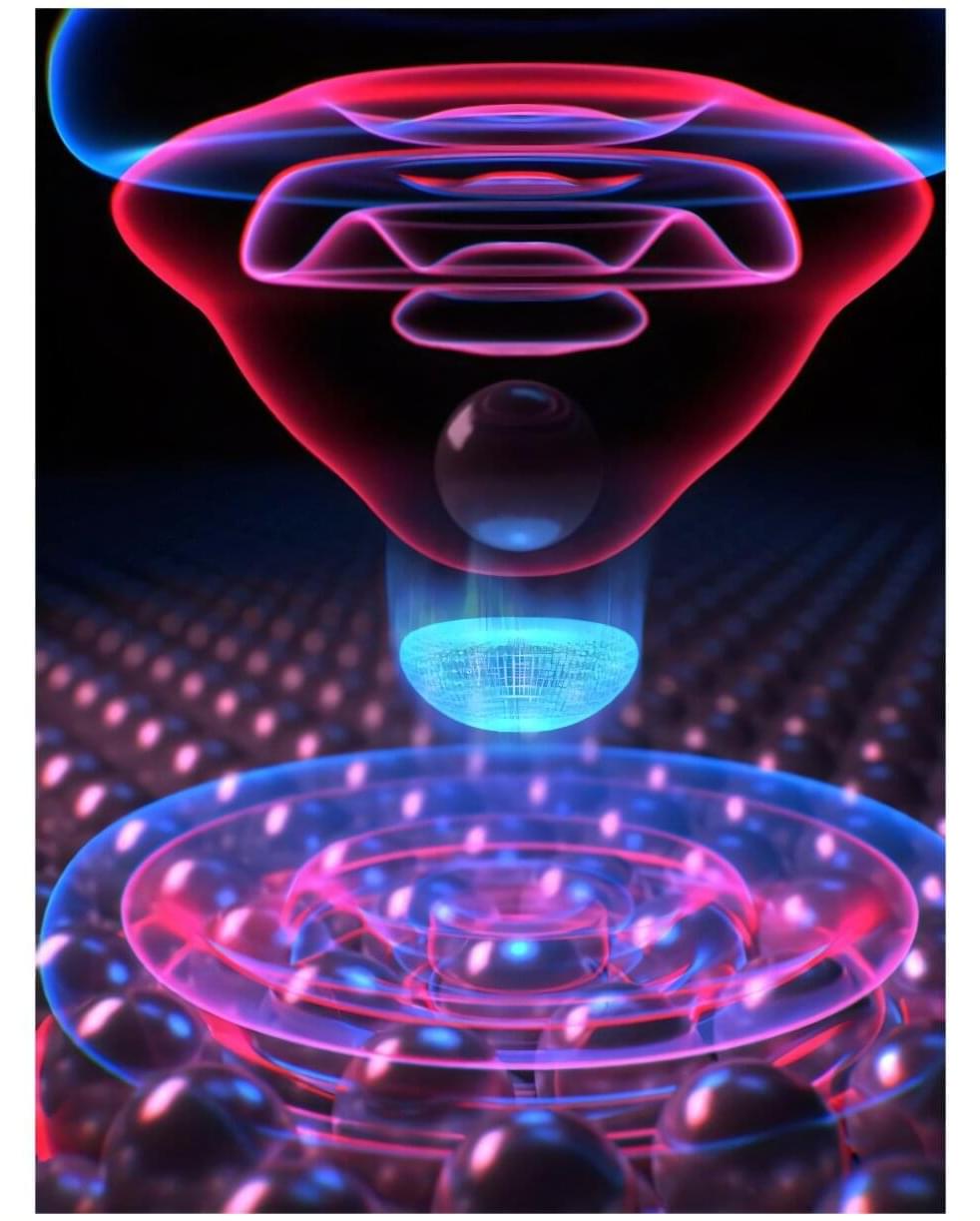
Werner Heisenberg’s famous uncertainty principle describes one of the most intriguing features of quantum physics: certain pairs of physical quantities describing a particle, such as position and momentum, cannot simultaneously be determined with arbitrary precision—not because of imprecise measuring instruments, but because nature forbids it. Between position and time, however, there is no Heisenberg uncertainty principle.
A research team comprising several groups at RUN led by Profs. Jascha Repp, Rupert Huber, Franz Giessibl, and Klaus Richter, as well as a team from the Max Planck Institute in Hamburg led by Angel Rubio, has now observed for the first time that the location and time evolution of an electron cannot be measured with arbitrary precision simultaneously. This so-called space-time limit has important implications for future applications. The work is published in the journal Nature Photonics.
Many future technologies, from green tech and quantum technologies to high-performance electronics for artificial intelligence, require a precise understanding of how matter functions at the microscopic level: how chemical reactions occur, how light interacts with matter, and how electrons move through electronic components. High-resolution still images of the microscopic building blocks of matter are not sufficient for this; rather, time-resolved slow-motion movies from the nanocosmos are needed.