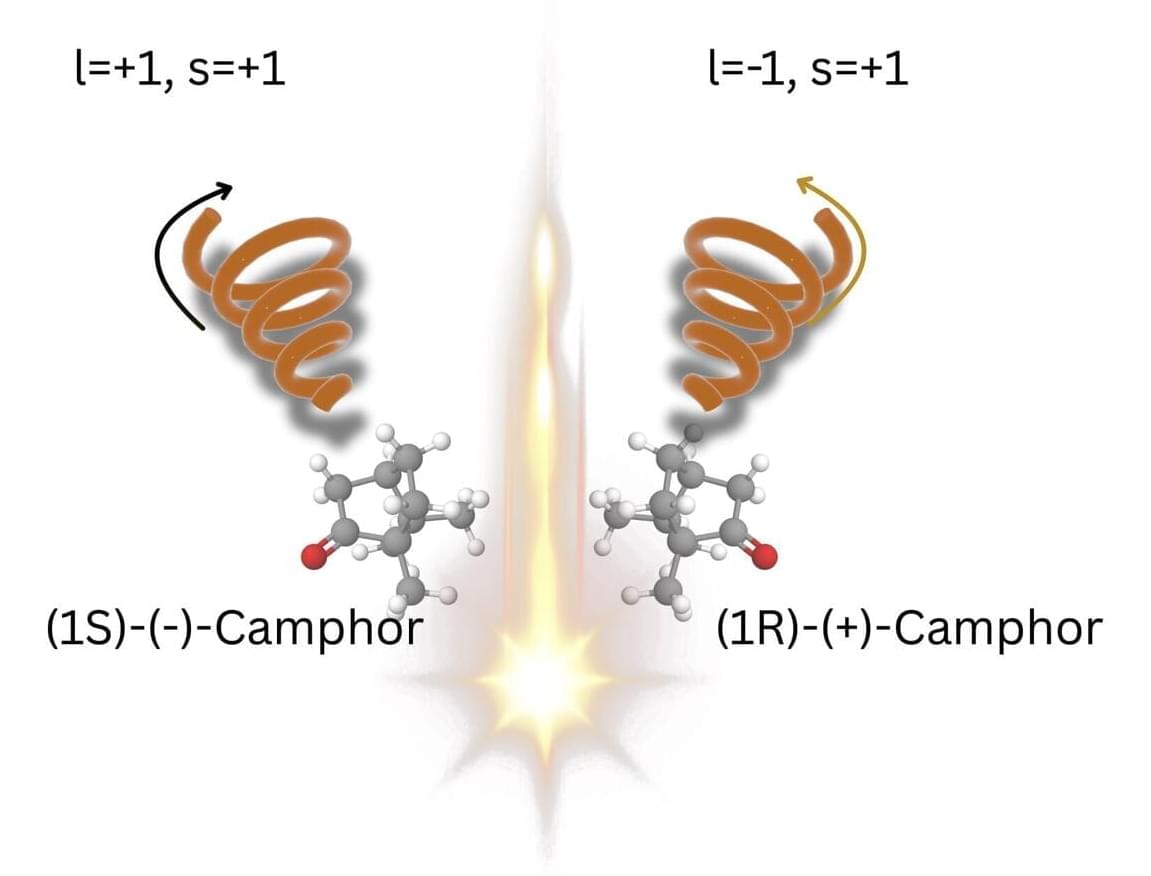
Many molecules exist in two mirror-image forms—like left and right hands—that look identical but can behave very differently, especially in biological systems and pharmaceuticals. Distinguishing between these enantiomers (also called chiral molecules) is a longstanding challenge in science and technology. A useful analogy is that of a screw and a nut: A right-handed screw fits only into a right-handed thread, while a left-handed one will not engage properly.
Researchers from Tata Institute of Fundamental Research, Indian Institute of Technology Bombay and Indian Institute of Technology Hyderabad illustrate how light itself can be engineered to behave like such a threaded probe, selectively interacting with molecules depending on their handedness.
The study, published in Science Advances, shows that light can be shaped not only to spin but also to twist as it travels. When such twisted light interacts with chiral molecules, the outcome depends sensitively on how the “twist” of the light matches the intrinsic handedness of the molecule.