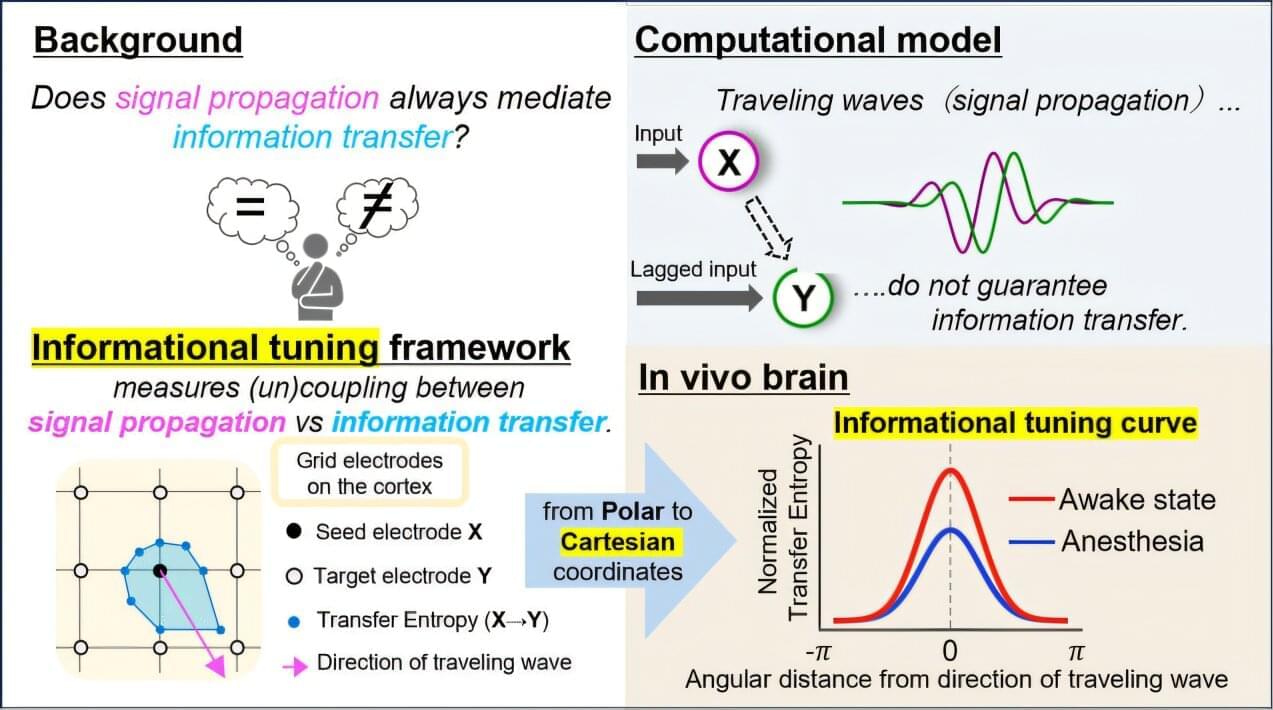
How and why we experience consciousness is a question that has long plagued philosophers and scientists alike. We have come to understand that, when awake, our brains organize neural information for perception, yet we completely lose this organization under anesthesia. Why this happens is a longstanding mystery in neuroscience, as simple changes in the activity levels of specific brain regions fail to explain this disappearance of consciousness.
Theories have hypothesized that conscious perception arises from two core pillars: the brain’s ability to encode external features and its ability to transmit information across different cortical regions. While the former has been well supported, direct physical evidence of the latter has remained elusive. A team of researchers at Kyoto University set out to bridge this critical gap between neural signals and information dynamics.
The paper is published in the journal iScience.