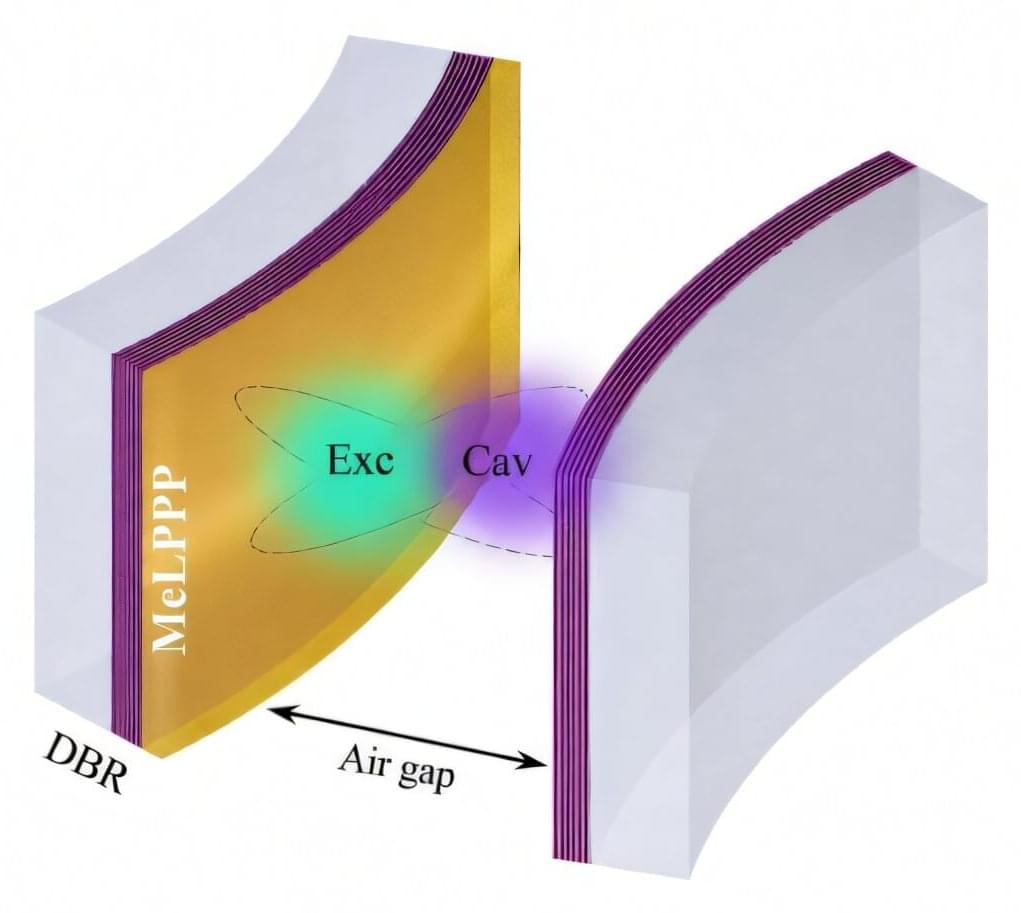
Researchers from Skoltech, together with colleagues from the N.D. Zelinsky Institute of Organic Chemistry and Westlake University, have experimentally demonstrated how the operating regime of a polariton laser changes with a gradual increase in cavity thickness.
They demonstrated a smooth transition between strong and weak coupling regimes within a single structure in the visible spectral range using the organic copolymer MeLPPP. The study opens opportunities for developing ultrafast optical transistors and room-temperature coherent light sources. The results of the study have been published in the journal Nanophotonics.
A polariton is a quasiparticle representing a hybrid of light and matter, formed through the interaction of photons with a semiconductor structure. When a critical density of polaritons in the sample is reached, their wave functions synchronize, and the quasiparticles relax to the lowest-energy state, forming a polariton condensate—a coherent macroscopic state and a source of coherent light.