The use of extracorporeal membrane oxygenation (ECMO) has expanded for severe respiratory and circulatory failure. Acute kidney injury (AKI) is one of the most frequent complications. Up to 85% of ECMO patients develop AKI and approximately half of them require renal replacement therapy (RRT) making a comprehensive understanding of both therapies and their interaction essential for patient management. However, evidence to guide ECMO-specific RRT strategies remains limited.
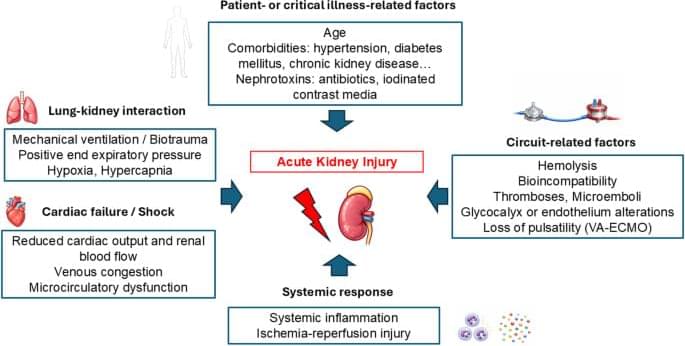
ECMO-related AKI arises from a complex interplay between patient and circuit factors that promote inflammation, endothelial injury, and tubular damage. Timing of RRT initiation in ECMO patients often relies on criteria used in the general critically ill population. Fluid overload is consistently associated with worse outcomes, and observational data suggest that earlier RRT, primarily to control fluid balance, may improve survival although randomized trials in ECMO patients are lacking. All RRT modalities can theoretically be used, but continuous techniques are preferred. RRT can be delivered via a parallel circuit using a dedicated venous catheter or integrated into the ECMO circuit. Integrated configurations reduce the need for additional vascular access and may prolong filter lifespan but require careful pressure management and team expertise to avoid alarms, hemolysis, and air embolism.