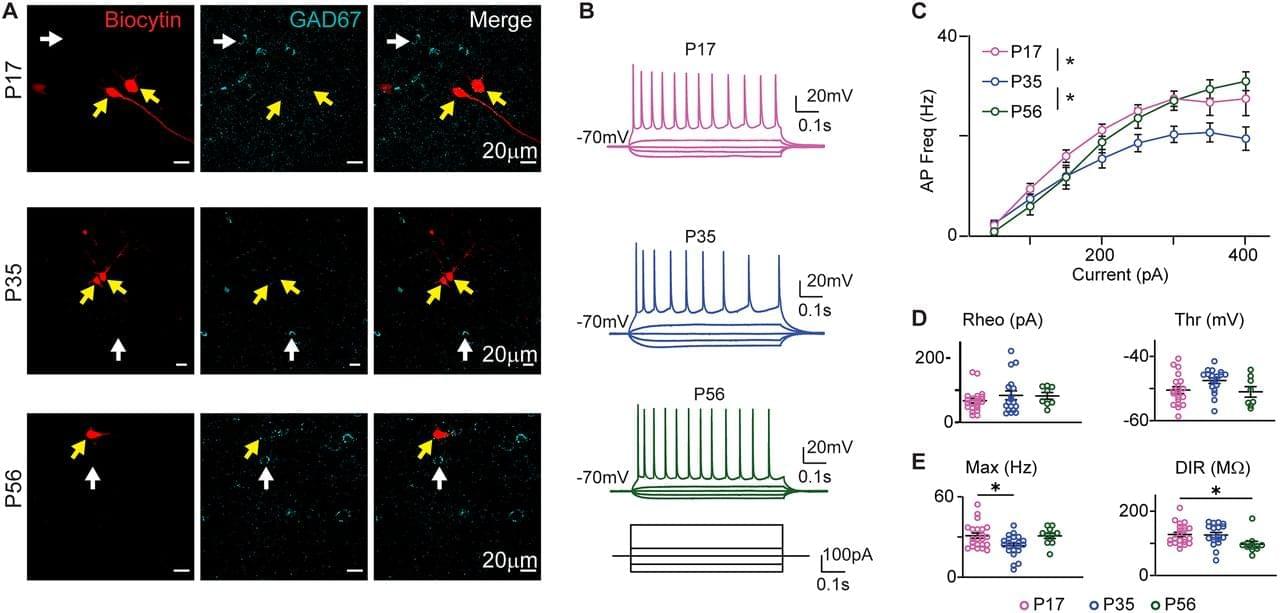
During postnatal development, mammals shift from relying on their mother’s milk to foraging for food. Early experience with feeding independence influences the development of taste preferences (Schiff et al., 2023). While the postnatal development of gustatory cortical circuits is not well studied, there is some experimental evidence for protracted maturation of neuronal morphology and early-life experience-dependent effects on neurons in other regions of the taste system. In mice, taste receptor cells begin to reliably fire action potentials during the third postnatal week (Bigiani et al., 2002) and the refinement of their excitability extends into adulthood (Bigiani et al., 2002; Ohtubo et al., 2012). Postnatal anatomical rewiring was observed in the first central relay in the gustatory system, the nucleus of the solitary tract (NTS) after postnatal day 21 (P21), with the inputs to the NTS reaching adult connectivity by P35 and undergoing additional refinement into adulthood (Hill et al., 1983; Sollars et al., 2006; May et al., 2008; Sun et al., 2017). In the gustatory portion of the parabrachial nucleus, dendritic arborization of multipolar and fusiform cells reach adult morphology by P35 (Lasiter and Kachele, 1988). Together, these studies identify the postnatal window between P15–P21, P21–P35, and P50–P65 as periods of maturation for different circuits in the gustatory system.
In primary visual, auditory, and somatosensory cortices, developmental time windows of heightened sensitivity to changes in sensory inputs extending between the third and fifth postnatal week have been identified (Micheva and Beaulieu, 1995; Antonini et al., 1999; Maffei et al., 2006, 2010; Maffei and Turrigiano, 2008b; Wang et al., 2011; Takesian et al., 2012, 2018; Gainey and Feldman, 2017; Gainey et al., 2018). During these periods, known as critical periods, cortical circuits undergo a maturation process that is shaped by experience and reach their adult properties.
GABAergic inhibitory synapses in particular play a crucial role in postnatal cortical circuit maturation and refinement. Inhibitory cortical circuits themselves undergo extended postnatal maturation (Hensch, 2004; Tatti et al., 2017; Takesian et al., 2018), with increases in GABAergic inhibition opening the critical period for circuit refinement. For instance, in a knock-out mouse in which GABA is severely diminished (GAD-KO), the critical period may never open unless GABA receptors are activated pharmacologically (Fagiolini and Hensch, 2000). Changes in inhibitory circuits during critical periods are primarily ascribed to parvalbumin-expressing interneurons (PV+ INs). Reports show an increase in the number of PV+ INs (Gonchar et al., 2007; Tatti et al., 2017) along with increased perisomatic innervation of pyramidal neurons (Chattopadhyaya et al., 2004). This process is associated with increases in the expression of PV in PV+ INs (Murase et al.