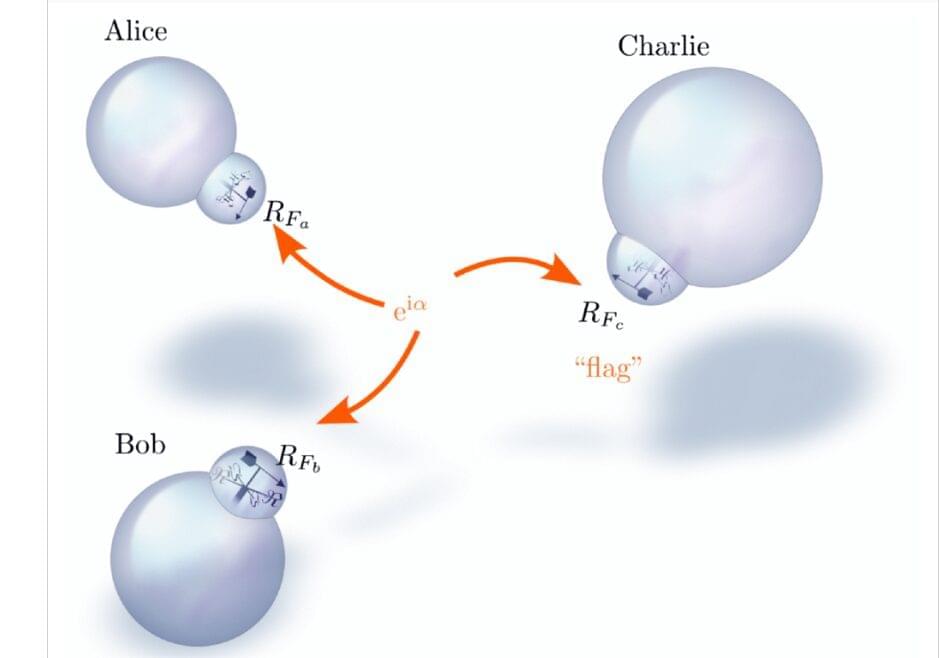
Physicists from Heinrich Heine University Düsseldorf (HHU) have examined a fundamental property of quantum mechanics in collaboration with the German Aerospace Center (DLR). In the scientific journal Physical Review Letters, they show that this theory does not necessarily need to be formulated with imaginary numbers – real numbers can in fact also be used.
Quantum mechanics is the branch of physics that explains how matter and energy behave at the atomic and subatomic scale. Developed in the early 1900s by pioneers including Max Planck, Niels Bohr, Werner Heisenberg, and Erwin Schrödinger, it has become one of the most successful scientific theories ever created.
The theory accurately describes a wide range of microscopic phenomena. These include the famous double slit experiment, in which particles also display wave like behavior, and quantum tunneling, where particles have a probability of passing through a barrier even when they do not have enough energy to overcome it in the classical sense. Other key quantum effects, such as entanglement and coherence, now form the foundation of emerging technologies including quantum computing and quantum communication.