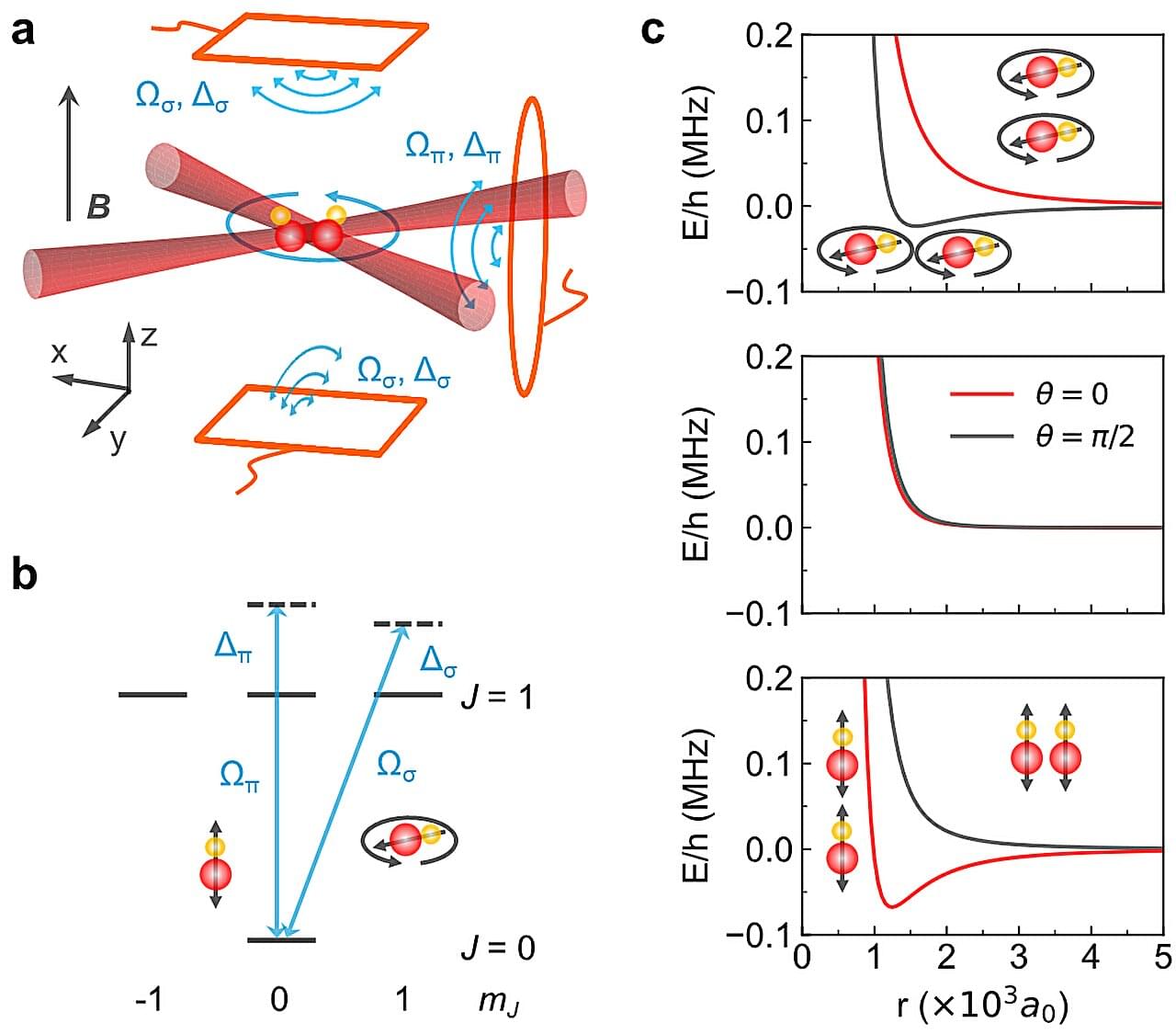
Bose–Einstein condensates are states of matter that form when particles called bosons are cooled to temperatures that are only a fraction of a degree above absolute zero (i.e., 0 Kelvin [-460°F]). In these states, particles occupy the same quantum state and exhibit interesting collective behaviors, essentially behaving as if they were a single “super-particle.”
So far, physicists have primarily created Bose–Einstein condensates using atoms. The first realization of these states with molecules was just over two decades ago, in 2003.
Producing Bose–Einstein condensates with ultracold polar molecules, cooled molecules in which positive and negative charges are separate, has proved particularly challenging. This is partly due to chemical reactions that can cause a loss of these molecules while they are being cooled.