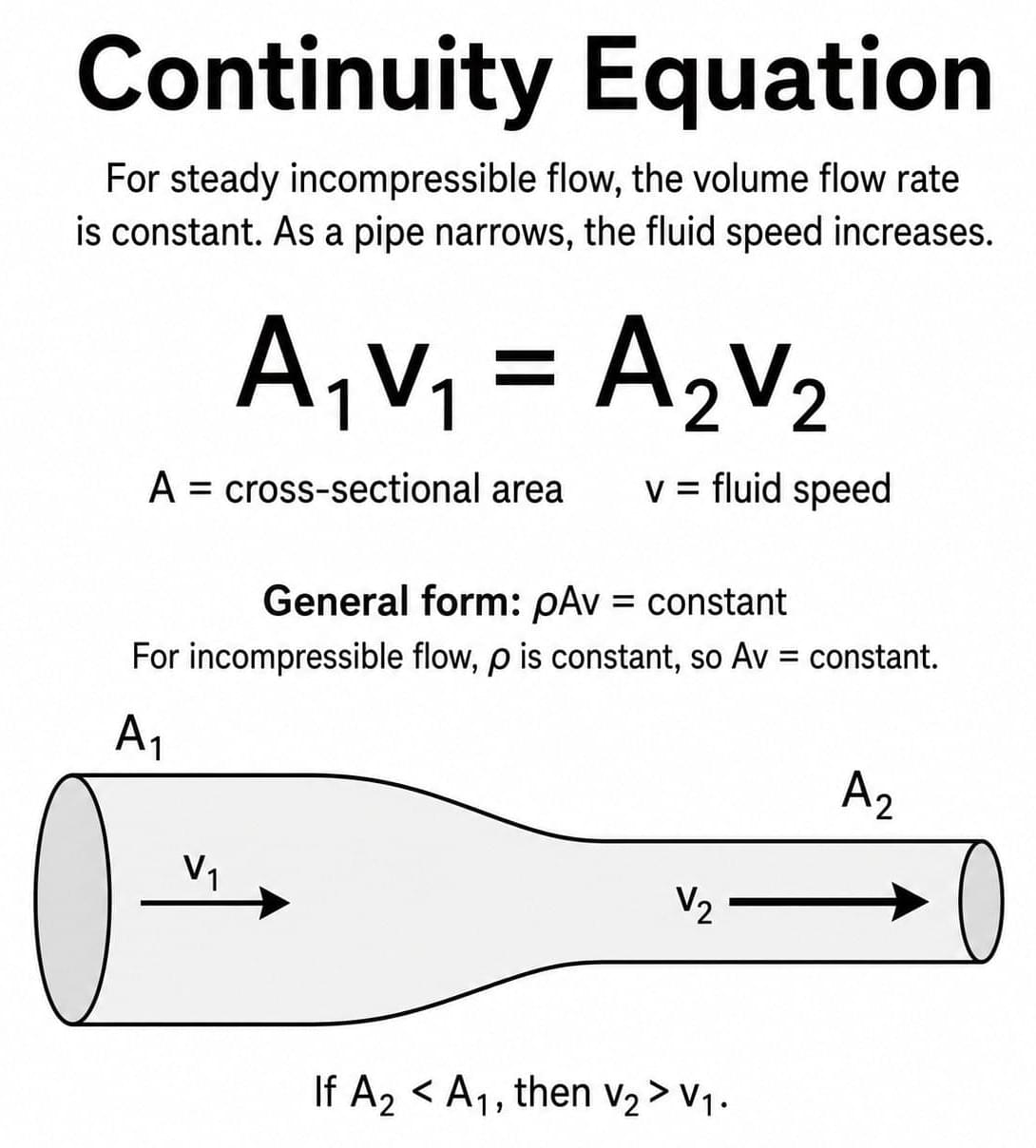
The continuity equation was not the work of a single physicist. Its development grew from early hydraulic studies and the work of Daniel and Johann Bernoulli. In the eighteenth century, Jean le Rond d’Alembert produced the first partial-differential expression of mass conservation in fluid motion, and Leonhard Euler soon placed it in the general mathematical framework that became the foundation of modern fluid mechanics. It should therefore not be attributed solely to Giovanni Battista Venturi, whose later work concerned flow through constricted tubes. Its general form is ∂ρ/∂t + ∇·(ρv) = 0 where ρ is fluid density and v is the velocity field. The equation says that mass cannot simply appear or disappear: any change in the amount of fluid inside a region must be explained by fluid entering or leaving it. For steady flow through a pipe, this becomes ρ₁A₁v₁ = ρ₂A₂v₂ If the fluid is effectively incompressible, its density remains constant, giving the familiar form: A₁v₁ = A₂v₂ The meaning is simple. The same volume of fluid must pass through every section of the pipe each second. When the pipe becomes narrower, the fluid must move faster; when it becomes wider, the fluid slows down. This equation is fundamental to the study of pipes, nozzles, rivers, aircraft flow, circulation systems and computational fluid dynamics. More broadly, continuity equations appear throughout physics wherever something locally conserved, such as mass or electric charge, moves through space. The equation is not merely about fluids; it is the mathematical language of the principle that what flows into a region must either flow out or remain inside.