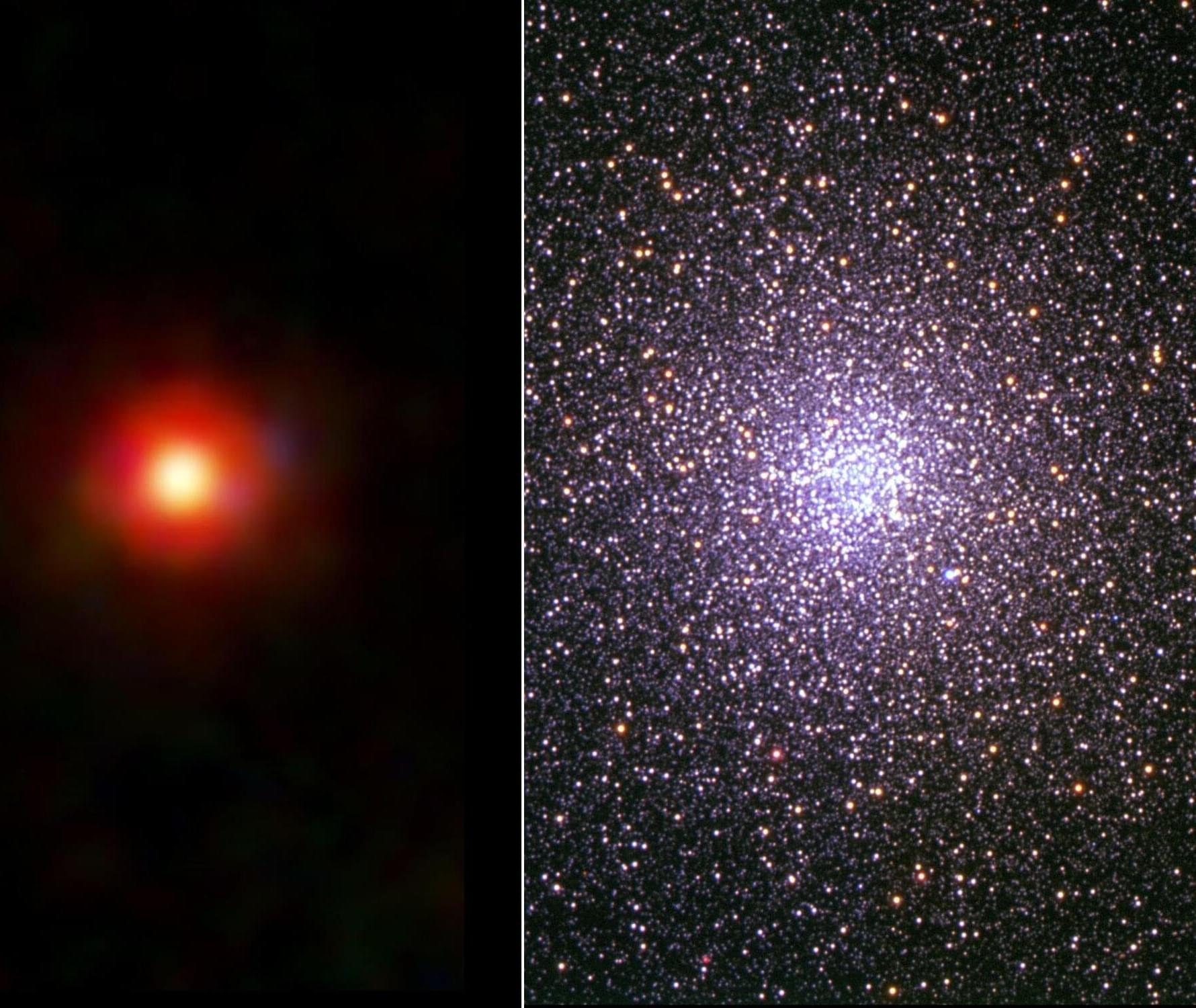
A new study led by astronomers at The University of Texas at Austin proposes a theory that could solve two astronomical riddles at once: the nature of Little Red Dots and the origin of globular clusters. Rather than representing distinct objects, the study suggests that one may instead be the ancestor of the other: Little Red Dots are, in fact, an early form of globular clusters. The findings are published in The Astrophysical Journal Letters.
First detected by the James Webb Space Telescope (JWST) in 2022, Little Red Dots are mysterious objects that appear 600 million years after the Big Bang, only to seemingly disappear 1.5 billion years later. They are compact, luminous and shine with a distinctive combination of red and ultraviolet light.
One theory is that Little Red Dots represent supermassive black holes, enshrouded in dense clouds of gas, that pull young stars into dramatic deaths. This scenario explains many of the objects’ signature properties. However, other scenarios could also fit.