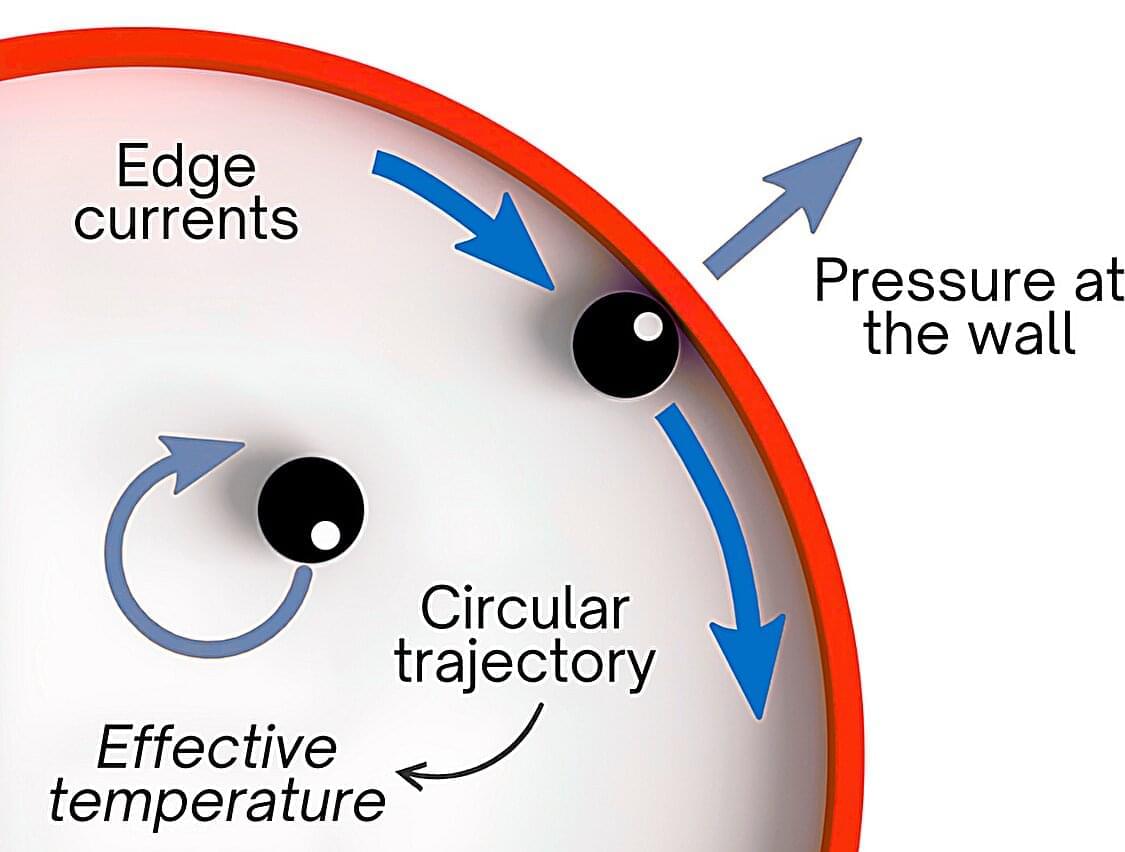
Physicists from Heinrich Heine University Düsseldorf (HHU), the Technical University of Darmstadt, Sapienza University in Rome and the University of Camerino (both in Italy) have calculated the fundamental laws of thermodynamics for a gas composed of spinning particles. In the scientific journal Proceedings of the National Academy of Sciences (PNAS), they demonstrate that the pressure of this gas is similar to that of a normal gas but at an elevated temperature. In addition, localized surface currents arise that can be used for targeted particle transport.
The so-called ideal gas law is one of the fundamentals of thermodynamics and states that the pressure of a gas is proportional to its density and temperature. From a microscopic perspective, pressure is the average force per unit area exerted by incoming particles on impact and reflection. At a higher temperature, the particles move more quickly and therefore exert greater pressure on impact.
A research team led by Dr. Hartmut Löwen from the Institute for Theoretical Physics II at HHU asked whether the ideal gas law also applies to self-propelled, so-called “active” particles or whether the nonequilibrium state results in significant differences. In addition to the physicists in Düsseldorf, colleagues from Rome, Camerino and Darmstadt were also involved.