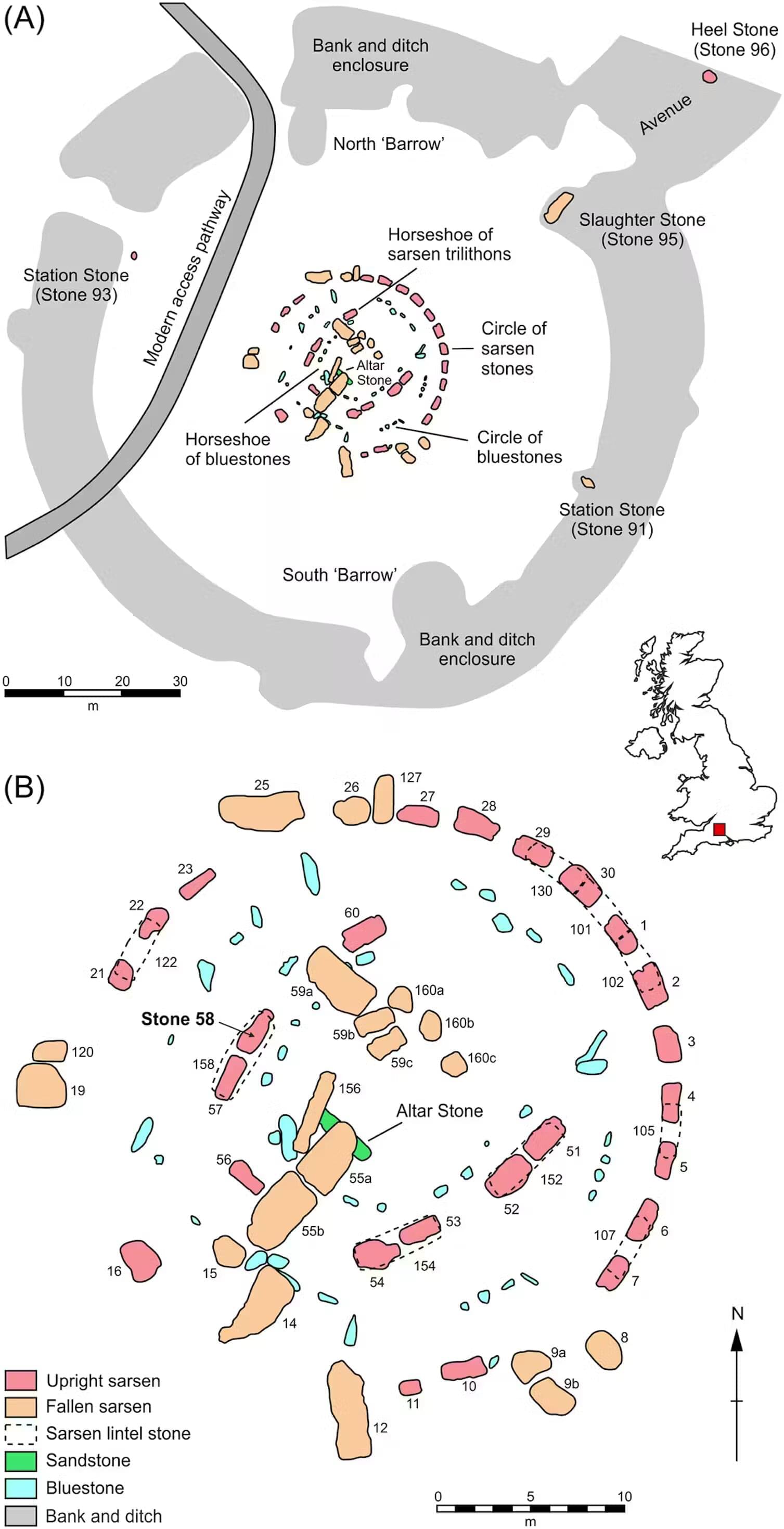
Built from stones weighing between 2 and 25 tonnes (2 to 28 tons), the structure of Stonehenge demonstrates a scale of construction hard to imagine before the invention of the wheel. The mystery deepens when you consider that the stones are not from the local bedrock. So why these stones, and how did they get there?
Recent work I carried out with geochemist Anthony Clarke from Curtin University in Australia might have an answer to these two questions for Stonehenge’s most far-traveled stone—the Altar Stone.
The Altar Stone was sourced from 700 km (435 miles) away in northeast Scotland, from a region of bedrock geology known as the Orcadian Basin that was once a lake called Lake Ocradie. The sandstone of the Altar Stone was formed from these lake sediments. Now, new work by our international team has tested the possibility that it was transported by glaciers.