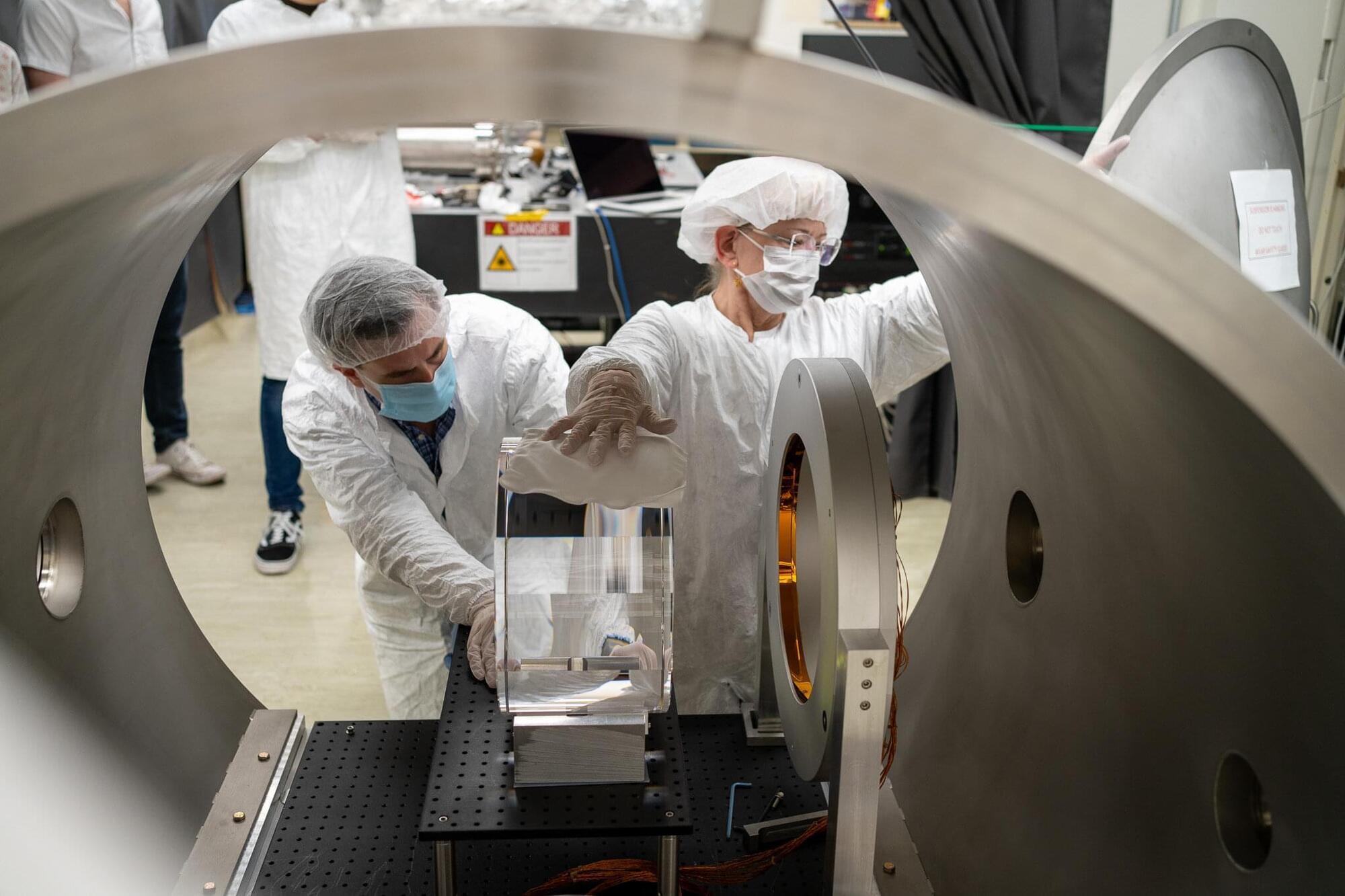
Scientists at the University of California, Riverside, have developed a new way to help gravitational-wave observatories see farther into the universe by solving one of their biggest challenges: tiny heat-induced distortions in the massive mirrors at the heart of the detectors.
The technique, described in a paper published in Classical and Quantum Gravity, uses thermal imaging to reveal microscopic distortions caused by powerful lasers. By measuring those distortions more precisely, observatories such as the Laser Interferometer Gravitational-Wave Observatory (LIGO) could improve their sensitivity and detect weaker, more distant gravitational-wave events.
The goal for the next generation of gravitational-wave detectors is to achieve about 10 times the sensitivity of today’s instruments,” said Jonathan Richardson, an associate professor of physics and astronomy at UC Riverside who led the study. “One of the key obstacles to achieving that is reducing the fundamental quantum-mechanical noise that limits the precision of the measurements.”