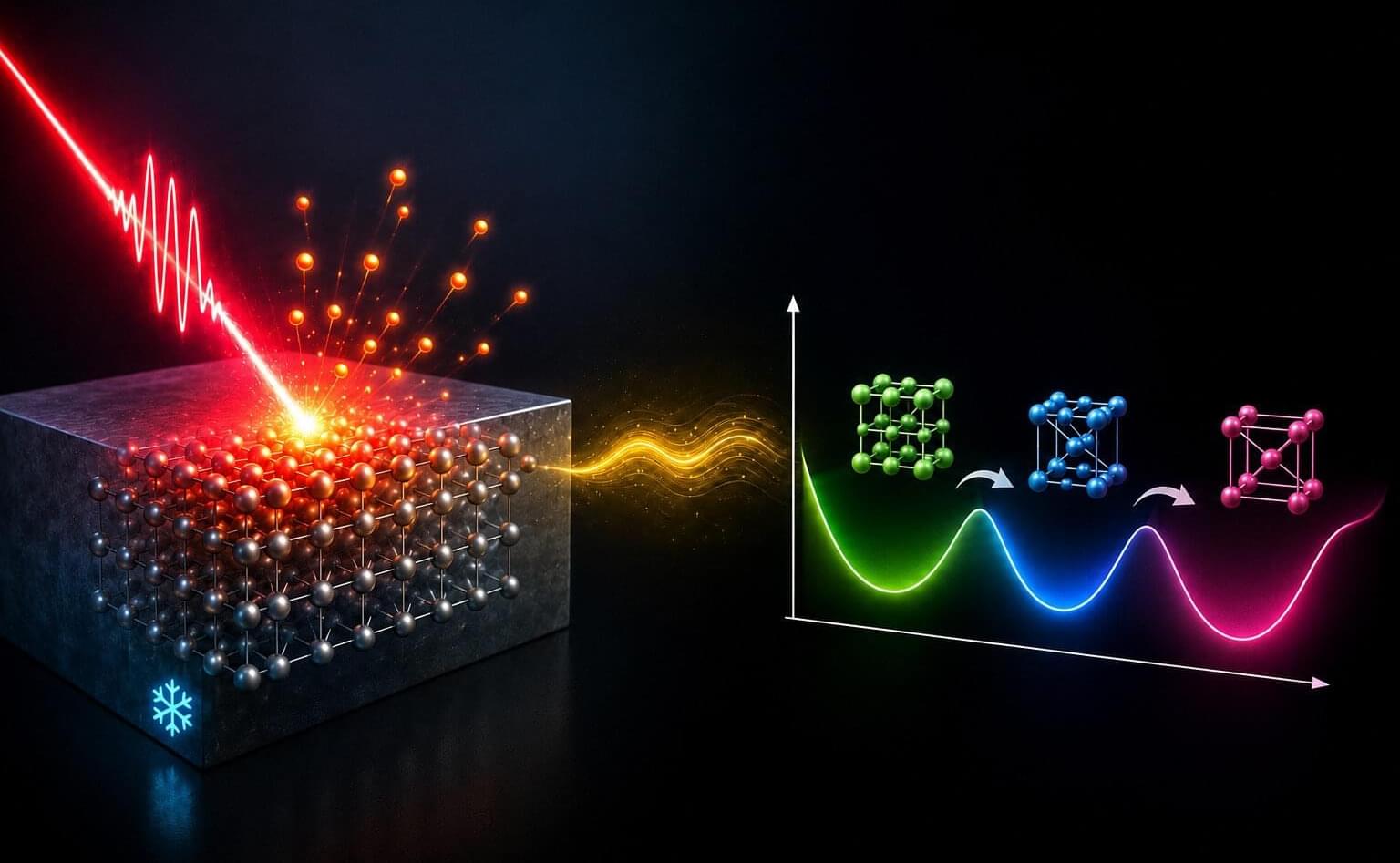
Researchers at The University of Manchester have revealed how intense electronic excitation can trigger rapid structural changes in metals—without heating the atomic lattice—offering new insight into ultrafast materials behavior.
When metals are exposed to powerful laser pulses, their electrons can heat up almost instantly, reaching extreme temperatures while the atoms themselves remain relatively cold. This study shows that, under these conditions, the behavior of the material is driven not by heat in the traditional sense, but by changes in the electronic system.
Published in Physical Review Materials, the research, led by Dr. Sam Azadi, demonstrates that this electronic “reheating” alone can cause metals to switch between different crystal structures in a fraction of a picosecond.