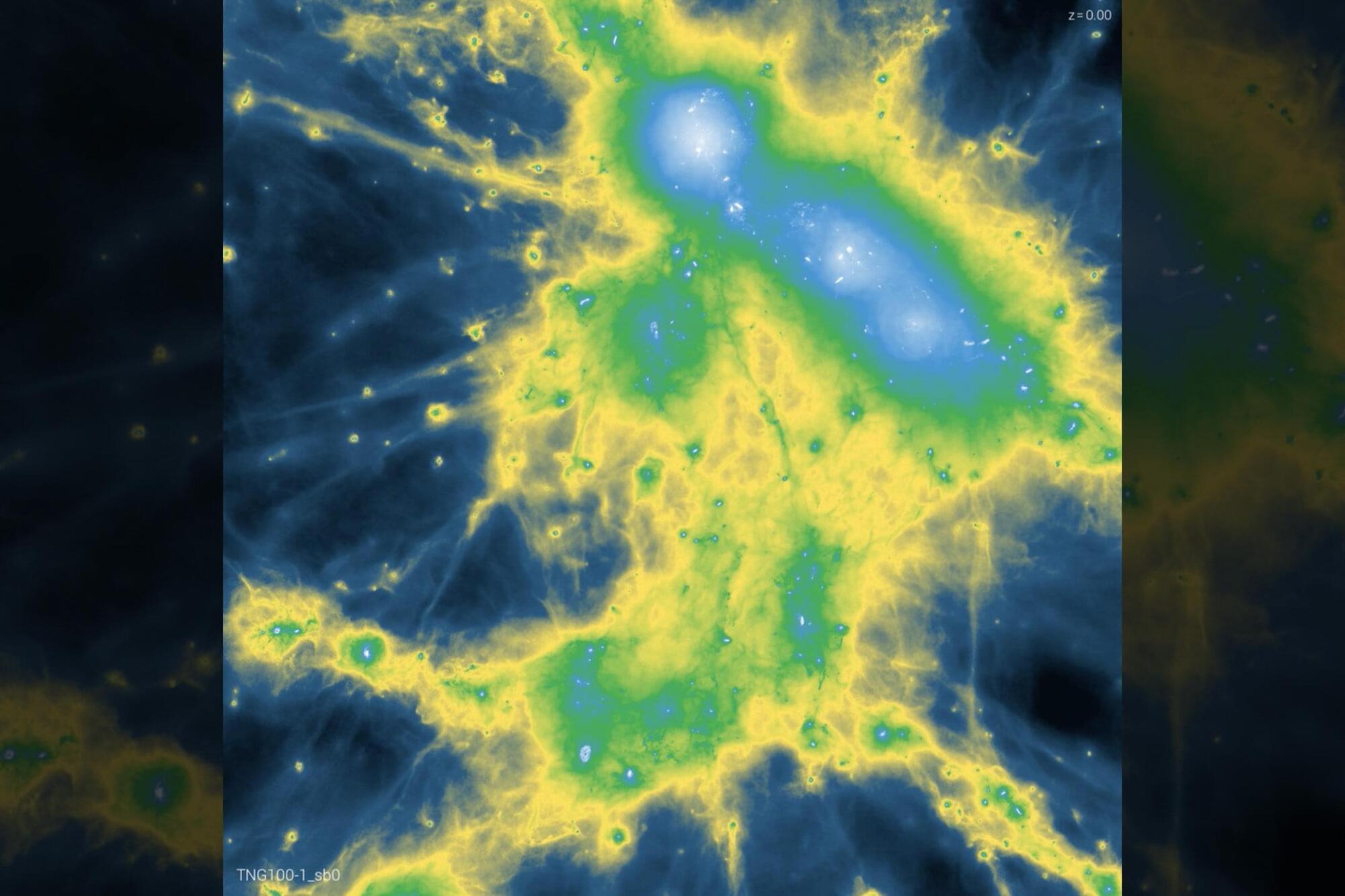
Stars and galaxies make up much of the universe’s ordinary, observable matter. But for decades, scientists have wrestled with a cosmic conflict: There should be much more.
Physicists have good estimates of how much matter was present in the early universe. Shortly after the Big Bang, roughly 83% of all matter in the universe was composed of invisible dark matter, with ordinary matter making up the rest. And yet, these estimates exceed the amount of ordinary matter seen in stars and galaxies today. Where, then, did all the missing ordinary matter go?
Now MIT scientists, as part of the CHIME/FRB Collaboration, are using far-off radio signals to reveal missing matter in the vast space between galaxies. The team has developed a new method to search out missing matter by combining locations of galaxies with detections of fast radio bursts.