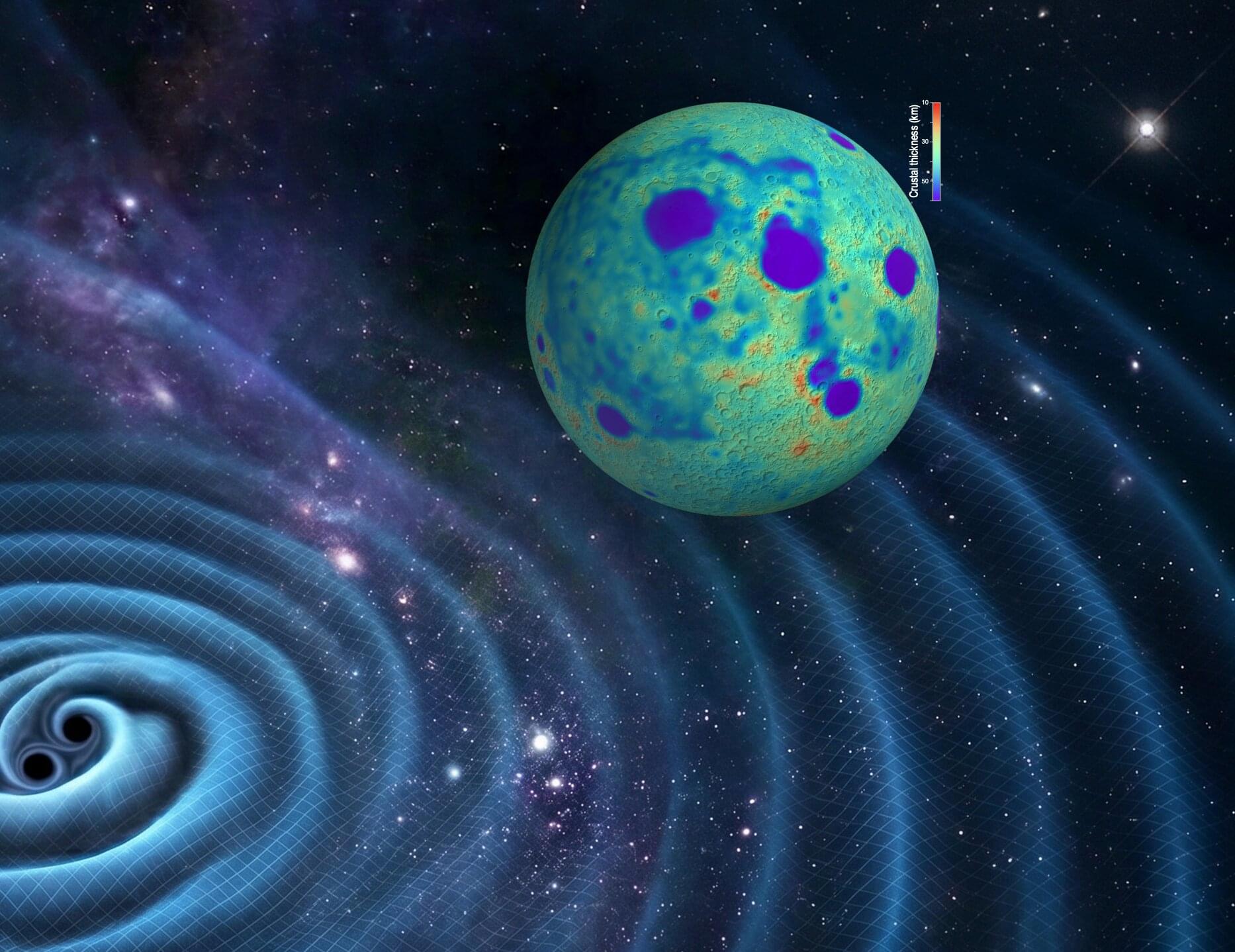
Gravitational waves are tiny ripples in the fabric of spacetime that are produced when massive objects in the cosmos accelerate or collide. By detecting these waves, astrophysicists can study various cosmic events, including black hole mergers, neutron star collisions and the early evolution of the universe.
There are several gravitational-wave observatories in different geographic regions worldwide. While these detectors are highly sensitive to the tiny changes associated with ripples in spacetime, they cannot yet detect waves across all frequency ranges.
Researchers at the Chinese Academy of Sciences and Peking University recently revisited the possibility of using the moon to amplify gravitational waves with frequencies between 0.01 and 1 hertz (Hz), a range that remains largely inaccessible to current gravitational-wave detectors.