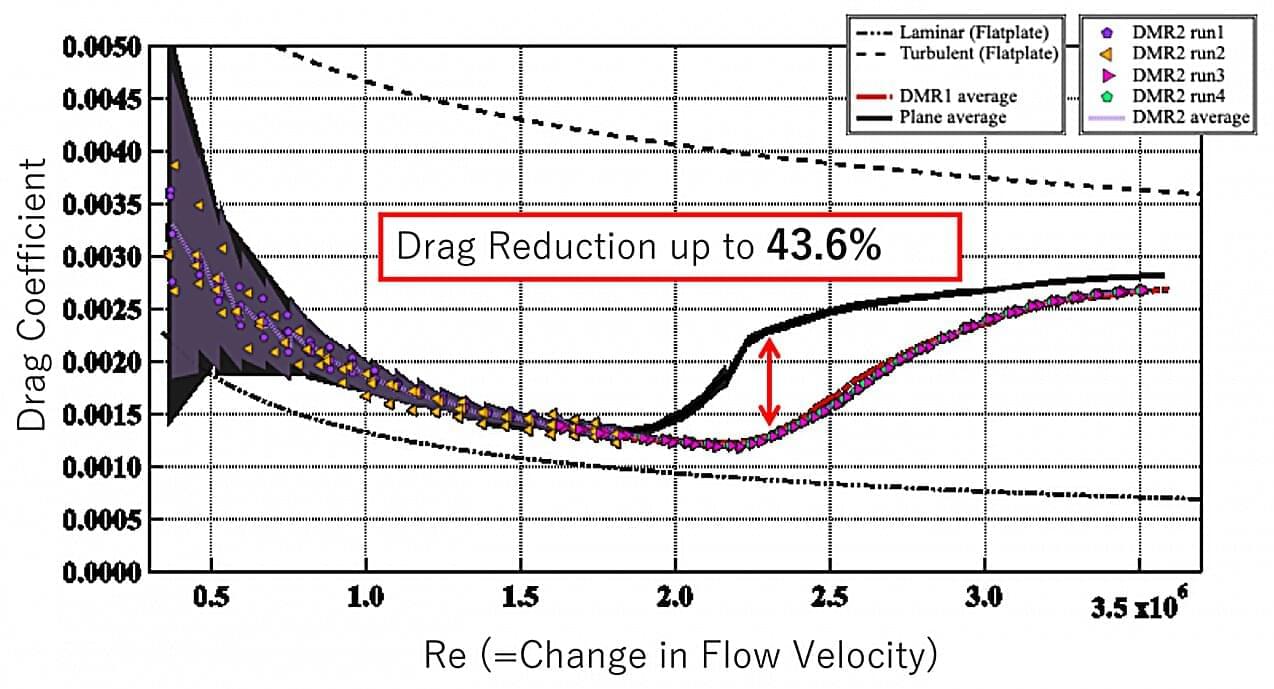
Logically, you would think a sleek surface has optimal aerodynamics—but recent research at Tohoku University turns this fundamental principle on its head. Applying an irregular microscale surface texture reduced the aerodynamic drag of a test model. The innovation has potential applications in the design of fuel-efficient vehicles. The study is published in the Journal of Fluid Mechanics.
For more than 80 years, a fundamental principle of fluid dynamics has held that smoother surfaces produce less aerodynamic drag. However, a research group led by associate professor Aiko Yakeno at the Institute of Fluid Science, Tohoku University, has overturned this long-standing assumption. By applying Distributed Micro-Roughness (DMR)—irregular microscale surface textures—to a test model, the team achieved the world’s first experimental demonstration of up to 43.6% aerodynamic drag reduction.
By reducing drag in this innovative way, researchers may be able to reduce fuel consumption and CO₂ emissions across aviation, automotive, marine and rail transportation in the future.