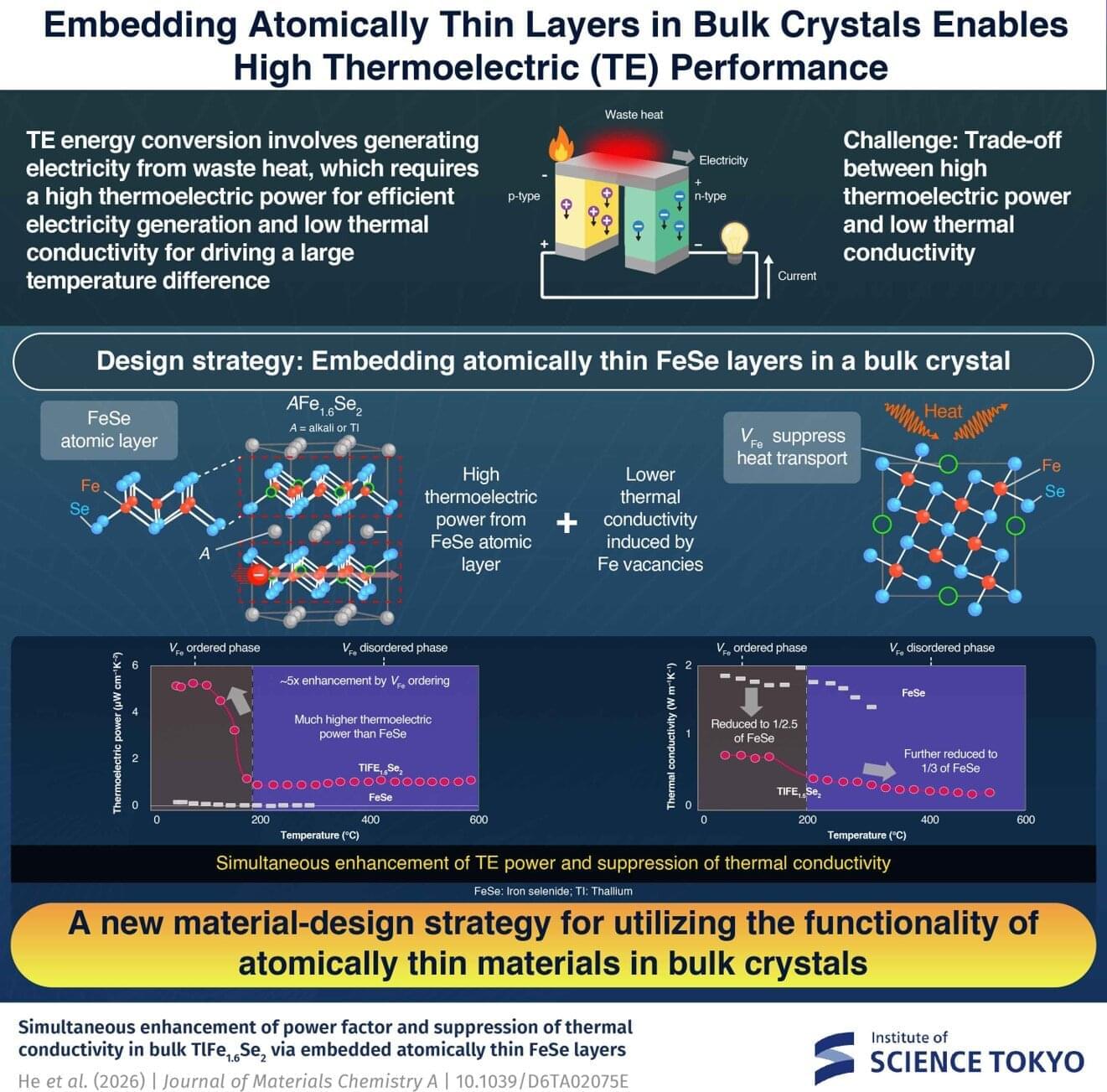
Developing thermoelectric materials that efficiently convert waste heat into electricity remains challenging because high electrical performance and low thermal conductivity are difficult to achieve simultaneously. Researchers at Science Tokyo developed a layered crystal, TlFe1.6 Se2, that embeds atomically thin iron selenide (FeSe) layers within a bulk material. The crystal combines a high thermoelectric power factor with exceptionally low thermal conductivity, demonstrating a promising strategy for designing next-generation materials for waste heat energy recovery.
Thermoelectric technology, which converts waste heat from factories, automobiles and power plants into electricity, is expected to play an important role in building a carbon-neutral society. In thermoelectric power generation, electricity is produced using a temperature difference across a material.
To achieve high power generation performance, materials must efficiently convert heat into electrical power while maintaining the temperature difference that drives power generation. However, these two requirements are generally difficult to satisfy simultaneously. Establishing new material design strategies that combine high thermoelectric performance with low thermal conductivity has therefore been a major challenge.