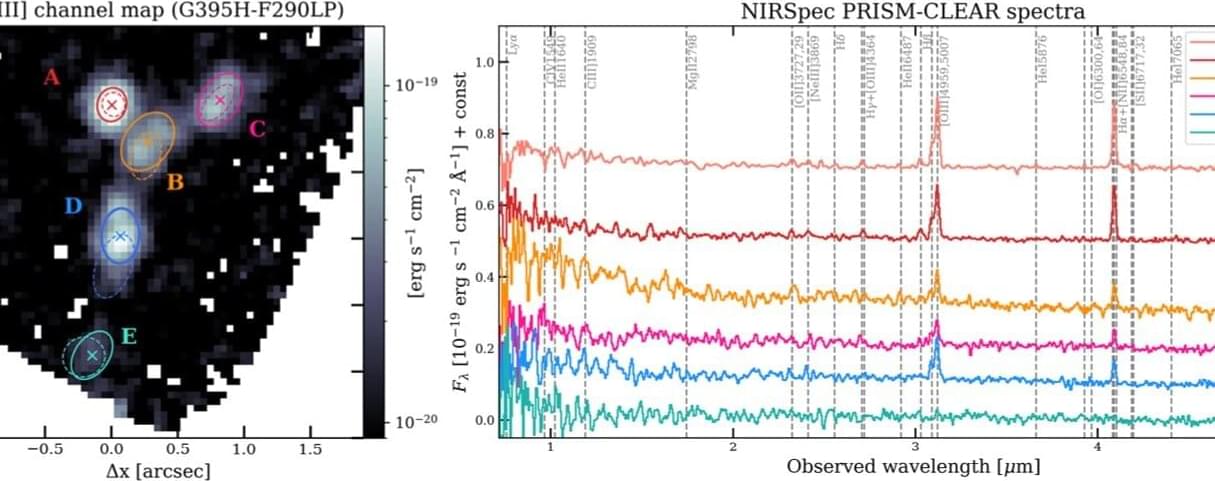
Astronomers using the James Webb Space Telescope have captured one of the clearest views yet of how an early supermassive black hole may grow within a network of young galaxies. The compact active galaxy, seen just a billion years after the Big Bang, lies beside a 12,000-parsec-long filament containing multiple galaxies that are expected to merge within a few hundred million years.
The findings, posted to the arXiv preprint server on July 6, suggest astronomers may be witnessing a short-lived phase in the evolution of rapidly growing black holes while also shedding light on how the first massive galaxies assembled in the early universe.