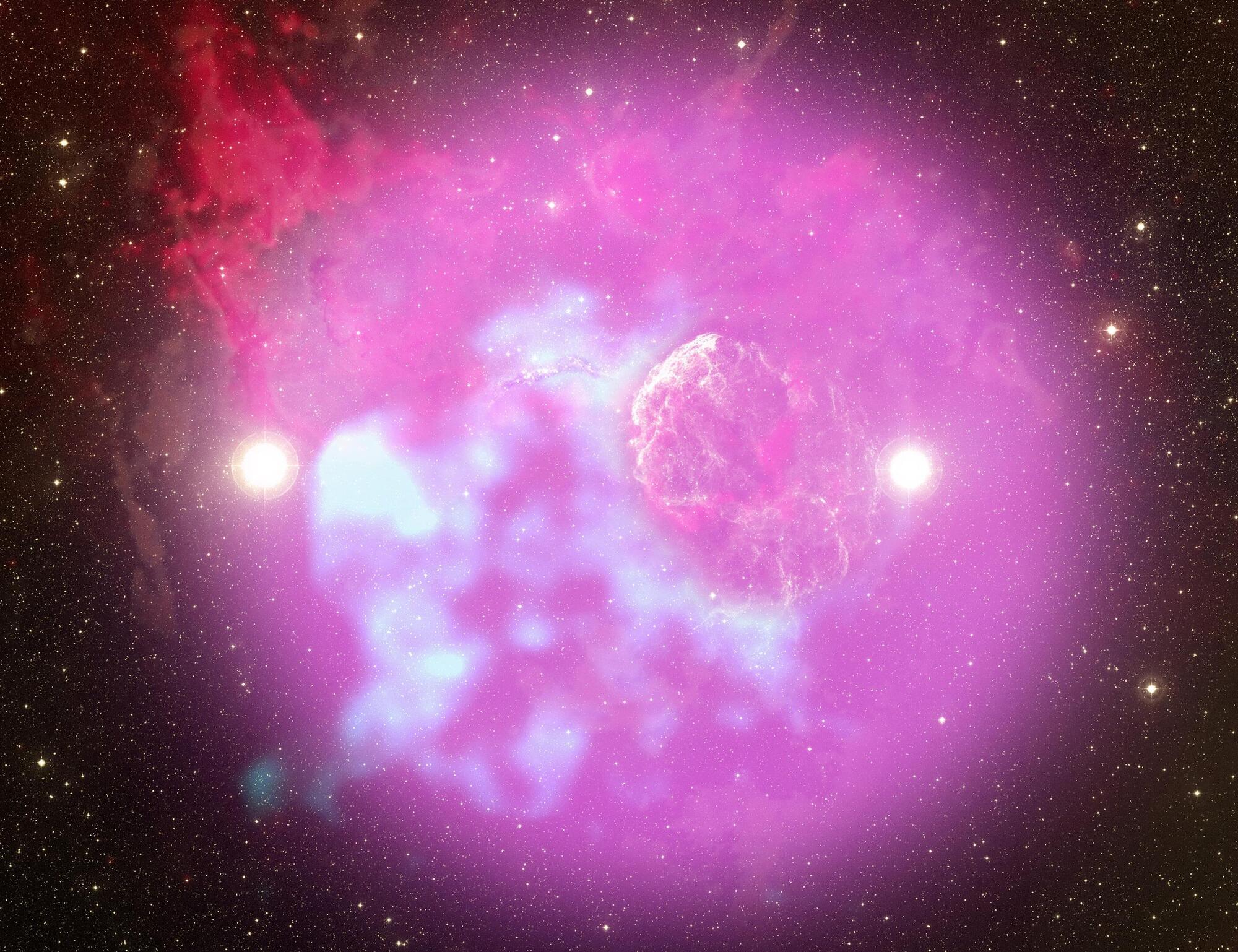
The star that formed the Jellyfish nebula may have had a partner star that exploded 100,000 years earlier, according to international researchers, who say that this may be the first known discovery of a binary star system in which both stars have gone supernova.
The Jellyfish nebula, known as IC 443, is the remnant of a star exploding in a supernova and leaving behind an expanding cloud of debris. IC 443 is located in the Gemini constellation, approximately 6,000 light-years from Earth, and researchers have now discovered that it occupies the same physical environment as another supernova remnant called G189.6+3.3. The findings are published in the journal Nature Communications.
Supernova remnants are expanding clouds of debris left behind after supernovae (stellar explosions). While hundreds of such remnants are known in our galaxy, identifying relationships between them is difficult, particularly in crowded regions of the Milky Way. IC 443, a remnant in the constellation Gemini approximately 6,000 light-years from Earth, sits close to other astronomical structures and within a complex cloud of gas and dust, making its surrounding region difficult to study.