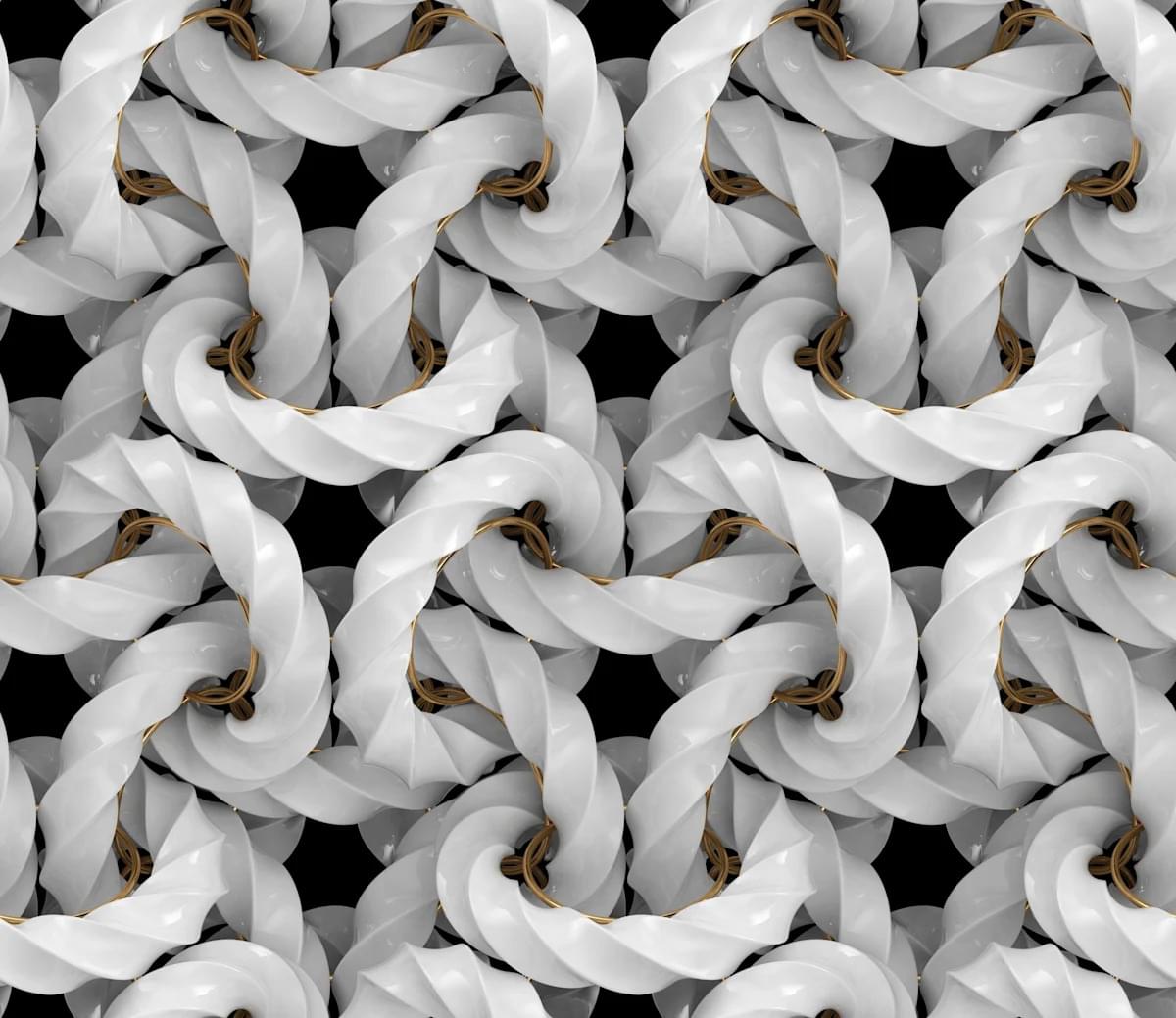
In the 1930s Werner Burau, a German mathematician, introduced a twisted geometrical mystery that would stand for nearly a century.
Previously, mathematicians had shown that knots could be reformulated into something more relatable: braids. A “braid” starts with a collection of strands. To make the braid, one dangles the strands vertically and weaves them downward however they like. Any type of knot, no matter how complicated, can be translated into a braid.
As part of his investigation, Burau neatly translated braid structures into algebraic objects, making them much easier to manipulate mathematically. The objects, called matrices, are grids of numbers that function much like a spreadsheet. But mathematicians of the day worried that his elegant translation was losing information. Did some of these matrices represent more than one braid? If so, they were dubbed “unfaithful.” The problem was determining which, if any, of his braid representations were unfaithful.