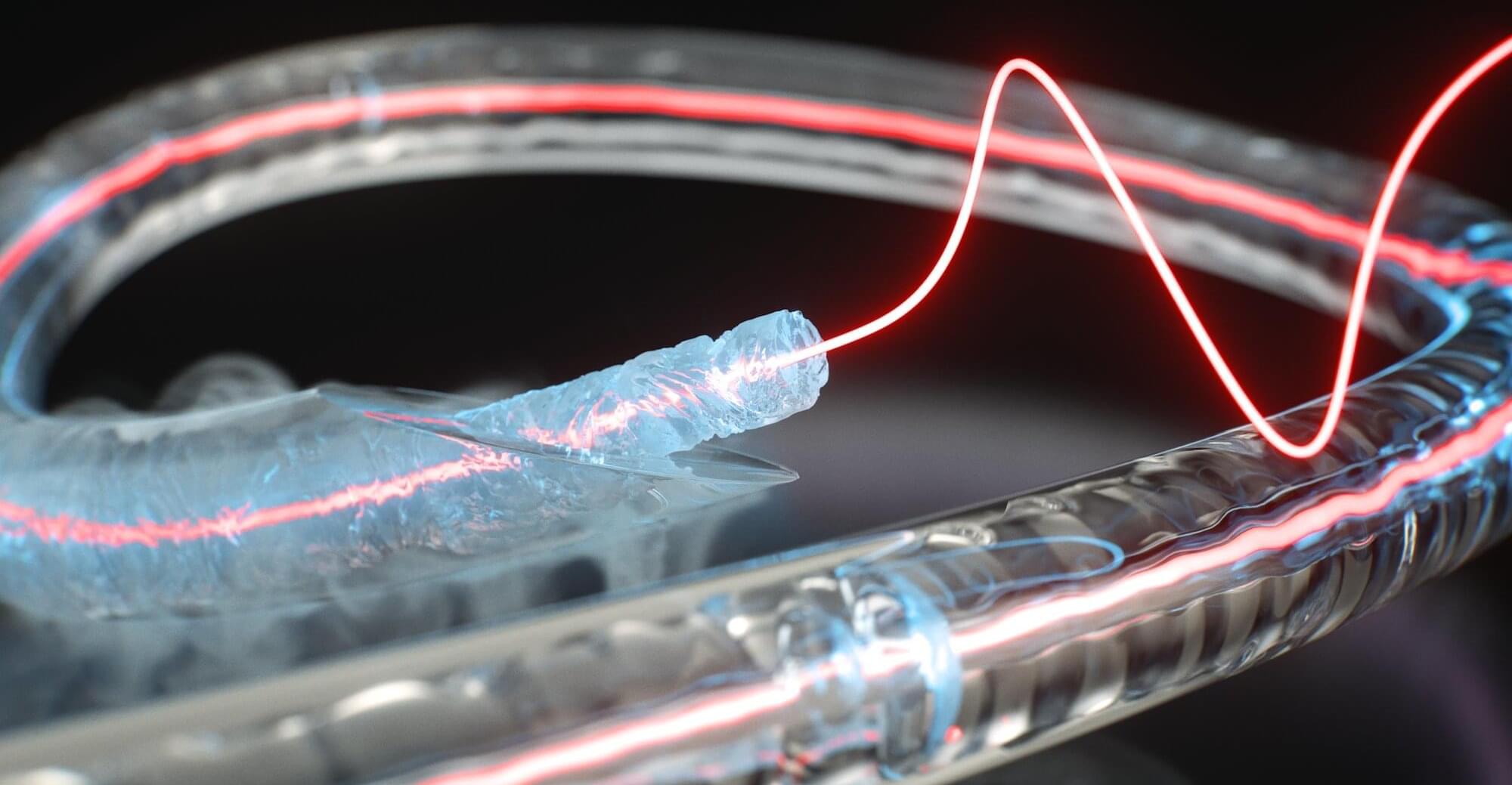
Researchers have developed a new type of optical fiber by freezing a glass capillary filled with liquid. It guides light and sound waves simultaneously and enables highly efficient coupling between them. The high coupling strength lowers the energy consumption of photonic neuromorphic computing schemes and quantum signal processing applications by several orders of magnitude.
When volcanoes erupt, one can observe streams of liquid lava cool and solidify into rock formations at the bottoms of volcanoes. The same physical process—a liquid changing into a solid phase upon cooling—can be observed when lakes start freezing during cold winters. These phase changes always come with changes in the physical properties of the material, such as the density or refractive index that govern how sound and light move through it.
This fundamental physical process is also used during the melting of glass preforms to loosen their structure while drawing optical fiber. These fibers then guide light through their cores, allowing the transmission of information via light very quickly over long distances, which is why they are widely used for telecommunications applications.