According to our best understanding, the universe is expanding – and is doing so at an accelerating rate. This is believed to be caused by something called the “cosmological constant”, which was first proposed by Albert Einstein in his theory of general relativity. In recent decades, it has become better known as dark energy, which is believed to make up about 70% of the universe.
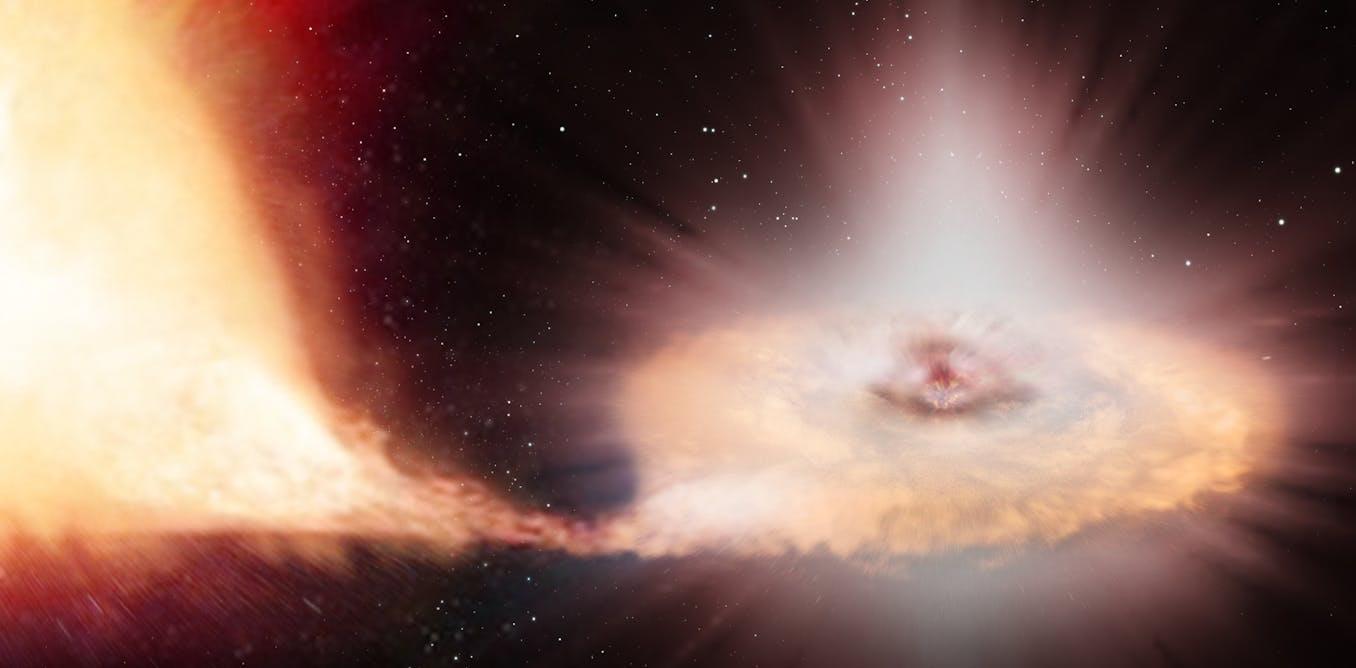
Crucial to this realisation were studies of Type Ia supernovae – exploding white dwarf stars. These are thought to emit a specific amount of light, which allows astronomers to determine their distances very accurately and thereby track the expansion of the universe. This work was awarded the 2011 Nobel prize in physics.
The accelerating expansion of the universe is thought to be due to negative pressure, an unusual property of dark energy that allows it to overcome the attractive force of gravity. Yet the exact nature of dark energy remains a puzzle. It cannot be explained by our best theory for the fundamental building blocks of the universe – known as the standard model of particle physics.