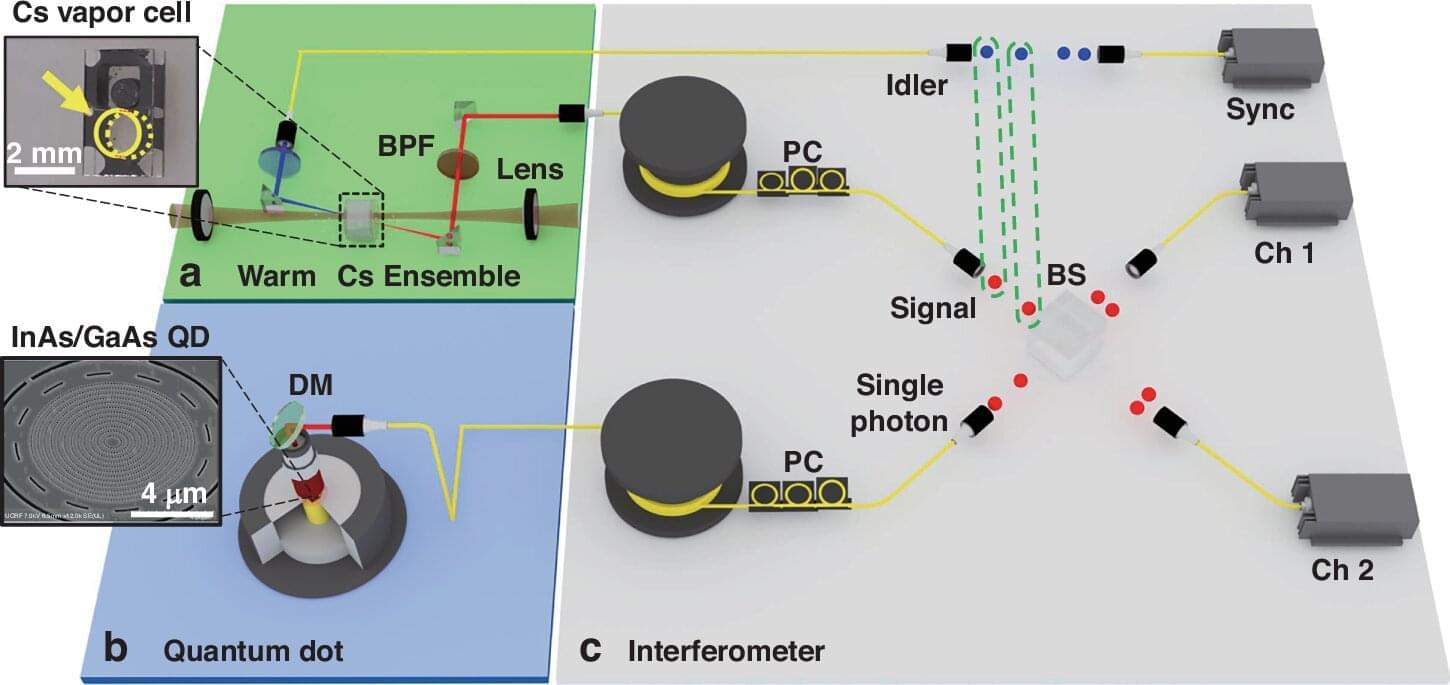
Large-scale quantum communication networks require both reliable quantum memories and coherent single-photon sources that can exchange quantum information efficiently. A coherent source of single photons with narrow linewidth, high brightness, spectral uniformity and compatibility with quantum memories is necessary. While a variety of single-photon sources, such as quantum dots (QDs) and atoms in warm vapor cells, have been developed in recent years, each has inherent limitations, making a scalable and functional quantum network challenging to achieve.
Hybrid quantum architectures that combine different quantum light sources can address these challenges. For example, QDs, which suffer from spectral randomness and are not well suited for photon storage, can be paired with atomic systems that provide reliable frequency standards and quantum memories. In such architectures, QDs can serve as bright, high-rate photon sources, while atomic systems handle photon storage and synchronization.
However, a key challenge in realizing such hybrid quantum architectures is interfacing different quantum light sources. Single photons emitted from different sources exhibit distinct spatial and temporal properties, necessitating modifications and synchronization that introduce losses and increase resource needs.