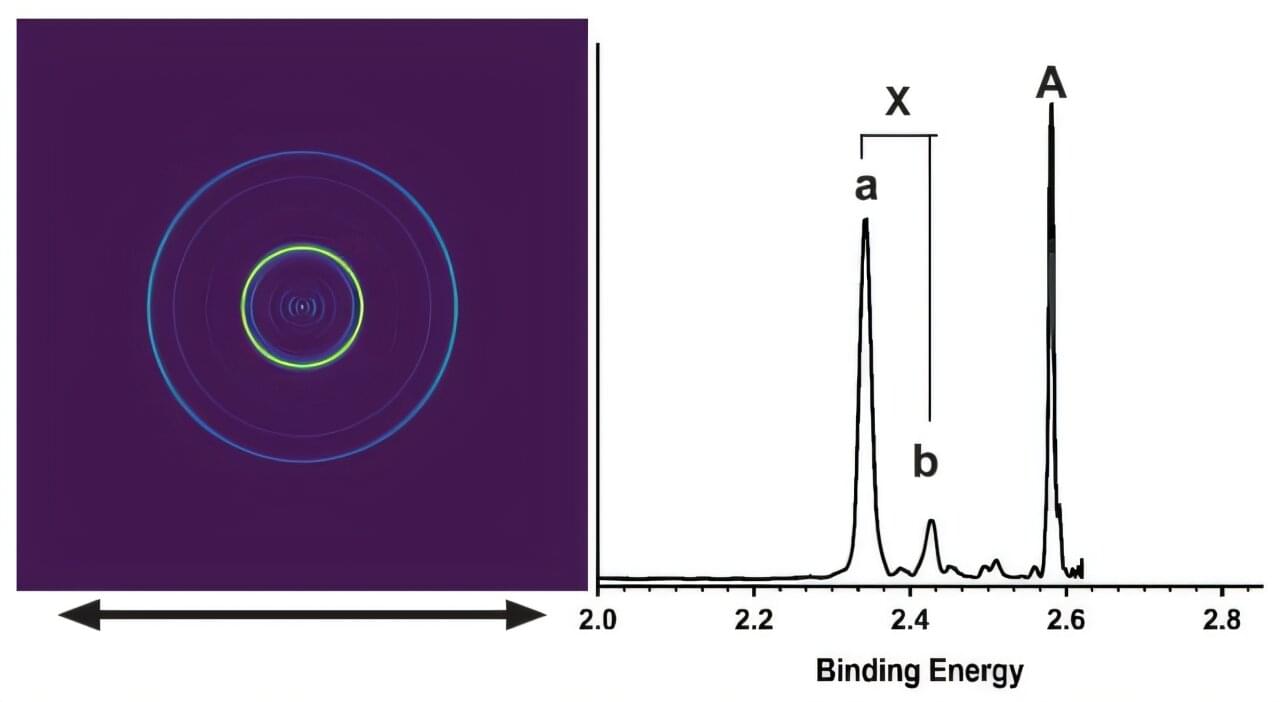
Brown University chemists have provided direct evidence that upends the textbook explanation of how triple chemical bonds work in heavy elements. In a study published in Science, the researchers show evidence that when atomic nuclei are sufficiently heavy, the principles described in Einstein’s theory of relativity change the structure of triple bonds—blurring the lines between the two separate types of bonds involved in textbook triple bonding.
Using a technique called photoelectron spectroscopy, the Brown team showed bonds created by carbon and the heavy element bismuth have the telltale signature of relativistic bonds.
“This idea that relativity is important in heavy elements has been around since the 1970s,” said Lai-Sheng Wang, a professor of chemistry at Brown and the study’s corresponding author. “But we show direct spectroscopic evidence that what we learned in high school about chemical bonding isn’t true in heavy elements.”