Butterfly gliomas are an aggressive subset of high-grade glioma characterized by bilateral hemispheric involvement. These patients often only receive biopsy followed by chemoradiation rather than surgical resection. Laser interstitial thermal therapy (LITT) provides a minimally invasive alternative that can improve survival.
We retrospectively compare outcomes in biopsy alone versus LITT cohorts. Demographic characteristics, perioperative outcomes, and survival metrics were analyzed. Within the LITT cohort, procedural and volumetric analyses were performed to examine the relationship between extent of ablation (EOA), residual tumor burden (RTB).
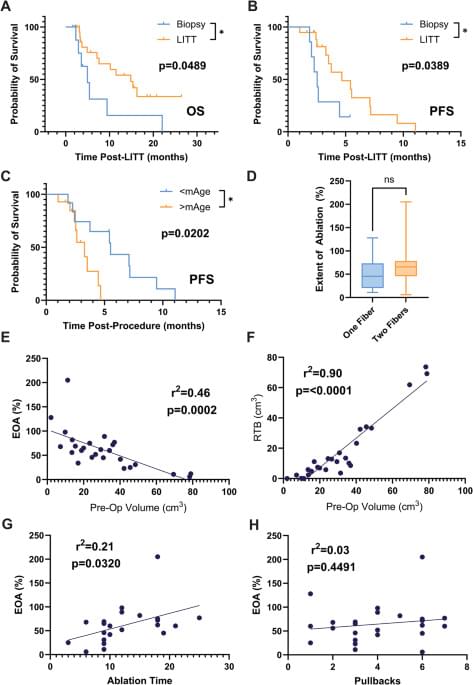
Of 44 patients, 15 underwent biopsy only and 29 received LITT was associated with a longer median overall survival compared to biopsy (14.86 versus 4.93 months, p = 0.0489), and median progression-free survival (4.67 versus 2.53 months, p = 0.0389). Within the LITT cohort, larger preoperative tumor volumes were associated with lower EOA (r²=0.46, p = 0.0002) and a higher RTB (r2 = 0.90, p = 0.0001). Longer ablation times correlated with a larger EOA (r2 = 0.21, p = 0.0320). Neither EOA nor RTB were associated with survival. Postoperative KPS improvement correlated with improved OS after multivariable Cox proportional hazards analysis (HR (death) = 0.93, 95%CI:0.87–0.99, p = 0.026), with a similar trend in PFS. Total operating room time was longer in the LITT group (median 4.0 vs. 2.57 h, p = 0.0034), while time-to-chemoradiation, ICU stay, and hospital stay were comparable. Post-operative re-admissions and complications were not statistically different between groups.