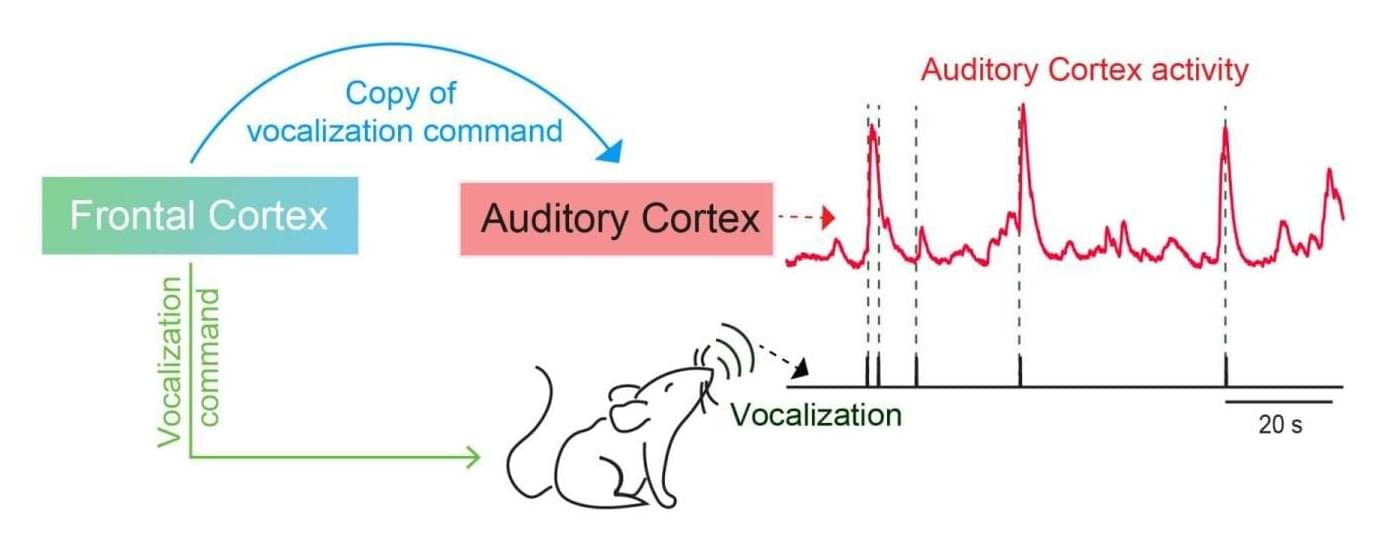
Long before a baby’s ears are functional, the brain is already building the circuitry needed for hearing, according to new research from Johns Hopkins University. Published in the journal Science Advances, the study in mice identifies a previously unknown neural “shortcut” that organizes the auditory system before birth, offering new insight into how the auditory system prepares to process sound and eventually learn language.
While it’s well-known that sound travels from the ear to the auditory cortex, the brain’s hub for hearing, Johns Hopkins researchers discovered a new neural circuit that bypasses the ear entirely. Their findings show that the frontal cortex—the region involved in vocalization—sends signals directly to the auditory cortex, allowing the developing brain to activate hearing-related circuits before external sounds can be heard.
“Our results provide the first direct functional evidence of this biological shortcut that doesn’t go through hearing,” says senior author Patrick Kanold, a professor of biomedical engineering and neuroscience at Johns Hopkins. “It’s a novel brain activity source that can shape the earliest development in mammals, like interpreting information and discerning complex sounds.”
In Near-Death Experiences (NDEs) memories since the 5th month of fetus-age are reactivated/recalled across the complete life-span in the same order as the physical senses develop: touch sense > ACOUSTIC SENSE > optical sense > birth(indirect) > early social- / environmental-experiences > autobiographical experiences since the 2nd year of childhood up to the actual age.
This does mean — that the neural structures which are used for these memories must exist across the COMPLETE LIFESPAN without any change — and that there is an organisation in the auditory system already in fetus-age.
Book source in German language: Kinseher Richard “Auflösung grosser Fragen: Was ist Bewusstsein? Was ist Zeit?”