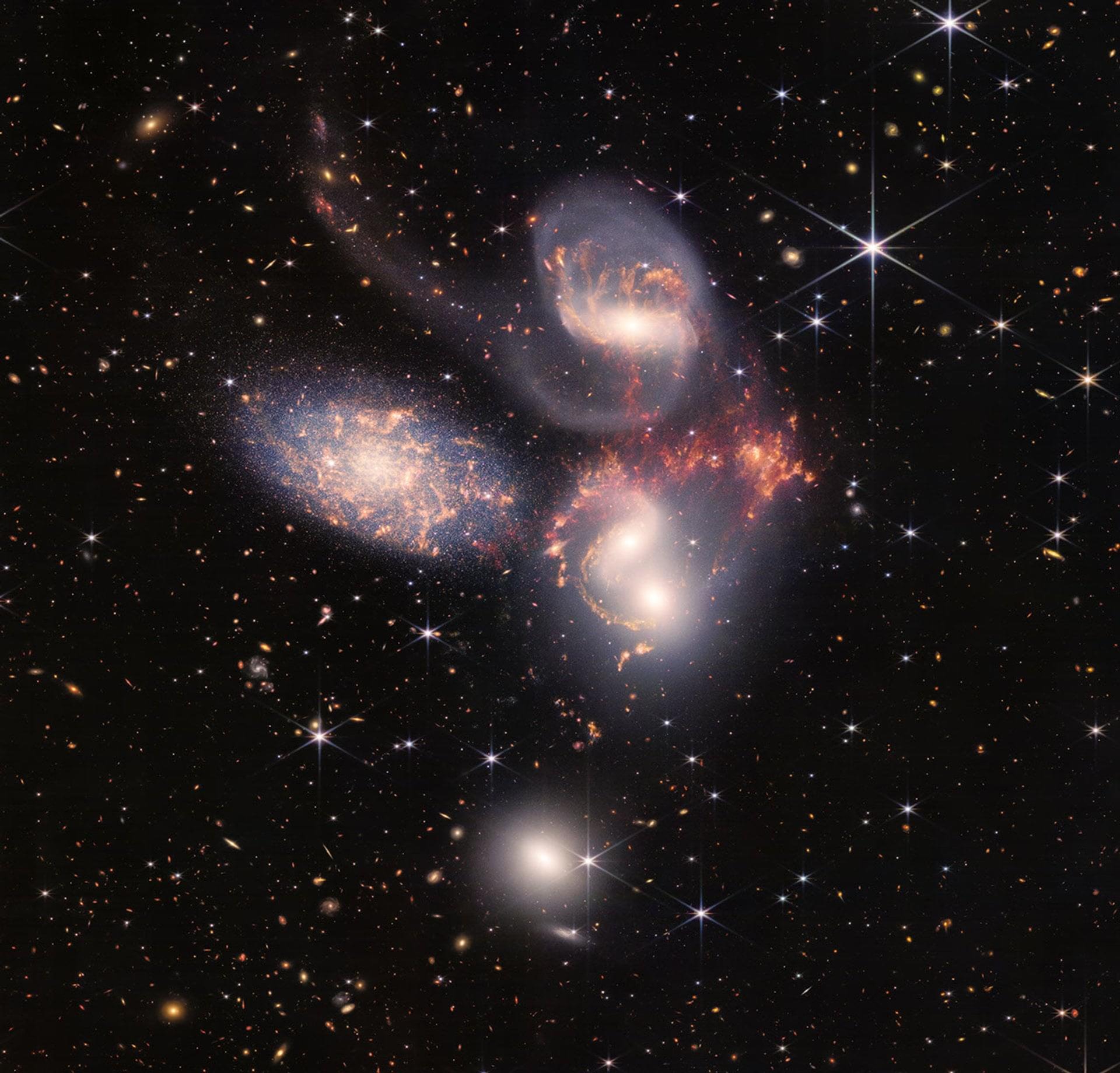
Scale in the universe is hard to understand from a purely human perspective. Many times, the math just doesn’t sit well with our brains, which evolved to capture and process data about the world around us rather than grok the complexities of stellar dynamics and galaxy mergers. But every once in a while, astronomers find something that, if we can wrap our heads around the numbers, gives a sense of just how big the universe is.
That is precisely what a new paper, available on the arXiv preprint server from a group of astronomers led by Z.L. Wen of the Chinese Academy of Sciences, hopes to do when it describes a merger of not one, not two, but six supermassive galaxies and the active dynamics they are subject to.
Admittedly, this paper isn’t the one that originally found the cluster. That was done back in 2018 by several all-sky surveys, including the Two Micron All Sky Survey, WISE and SuperCOSMOS. But it was the first to identify that the cluster contained a group of six merging galaxies at its heart. That tidbit was hidden away in Dark Energy Spectroscopic Instrument (DESI) Legacy Imaging Surveys data.