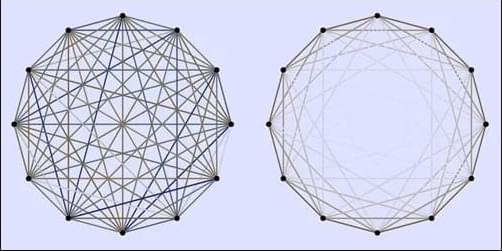
The Sachdev-Ye-Kitaev (SYK) model describes information scrambling in black holes and an unusual metallic phase in high-temperature superconductors. Despite those and other far-reaching applications, realizing the model in the lab has been extremely challenging because the particle interactions required are intricate and long-ranged. Now Charles Creffield at the Complutense University of Madrid and his colleagues have detailed how this model could be simulated in existing cold-atom setups [1]. Their strategy provides a practical path to exploring quantum phenomena that are currently confined to theory.
Rather than engineer the requisite particle interactions from the outset, the team started with a much simpler setup emulating the Hubbard model, which is used to understand how electrons moving in a lattice give rise to superconductivity and other phenomena. Ultracold atoms are placed in a one-dimensional optical lattice, where they hop between lattice sites and mutually repel each other when occupying the same site. The lattice is then periodically shaken to make the rate of hopping oscillate in time. This modulation suppresses the atoms’ ordinary motion and generates effective interactions between all the atoms at once, closely resembling the particle behavior of the SYK model.
Using detailed numerical simulations, the researchers went on to show that their Hubbard-based system reproduces several key features of the SYK model, including its characteristic chaotic dynamics and fast spreading of quantum information. The team emphasizes that its approach could be enacted straightforwardly using currently available cold-atom technologies. Such an implementation would offer a controlled, versatile platform for simulating the SYK model and possibly for probing the uncertain physics of quantum chaos and quantum gravity.