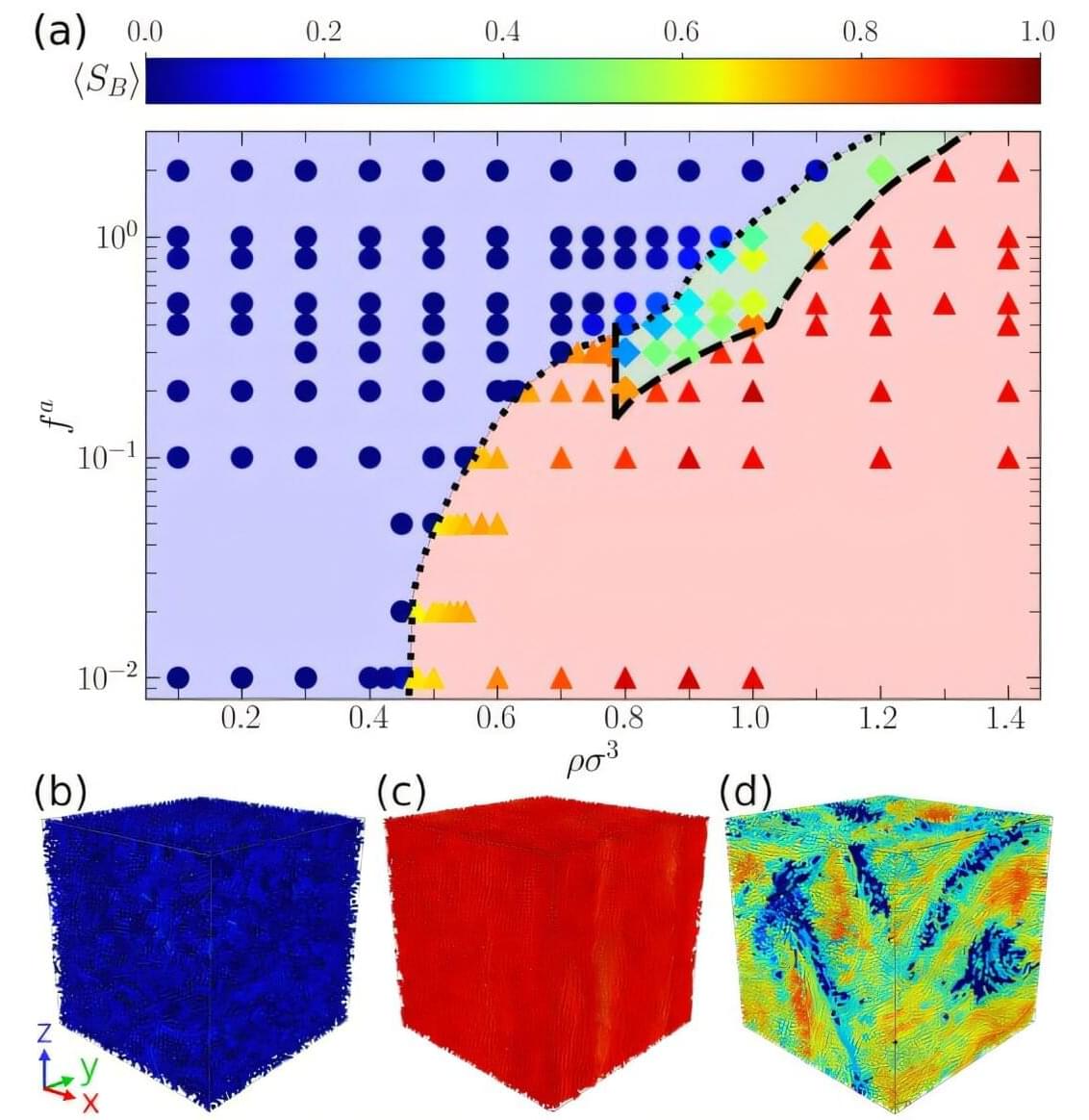
Pack enough string-like objects together, and they will begin to align with one another. But replace the strings with worms or bacteria living in your gut, and this self-organization becomes much more difficult. A team of University of Amsterdam (UvA) researchers has demonstrated that activity can fundamentally alter one of the most important phase transitions in soft matter physics.
Many systems in nature spontaneously organize themselves: Bird flocks align their flight directions, schools of fish move collectively, snakes and worms protect themselves by forming tight entangled clusters, and even molecules can coordinate their orientation to form ordered phases.
For string-like objects, or filaments, a key transition happens when you increase how densely they are packed together. If the density is low, they point in random directions, much like a crowd of people walking aimlessly through a city square. Physicists call this the isotropic phase. As more filaments are added, however, they begin to align with one another. Eventually, most filaments point roughly in the same direction, creating an ordered state known as a nematic phase.