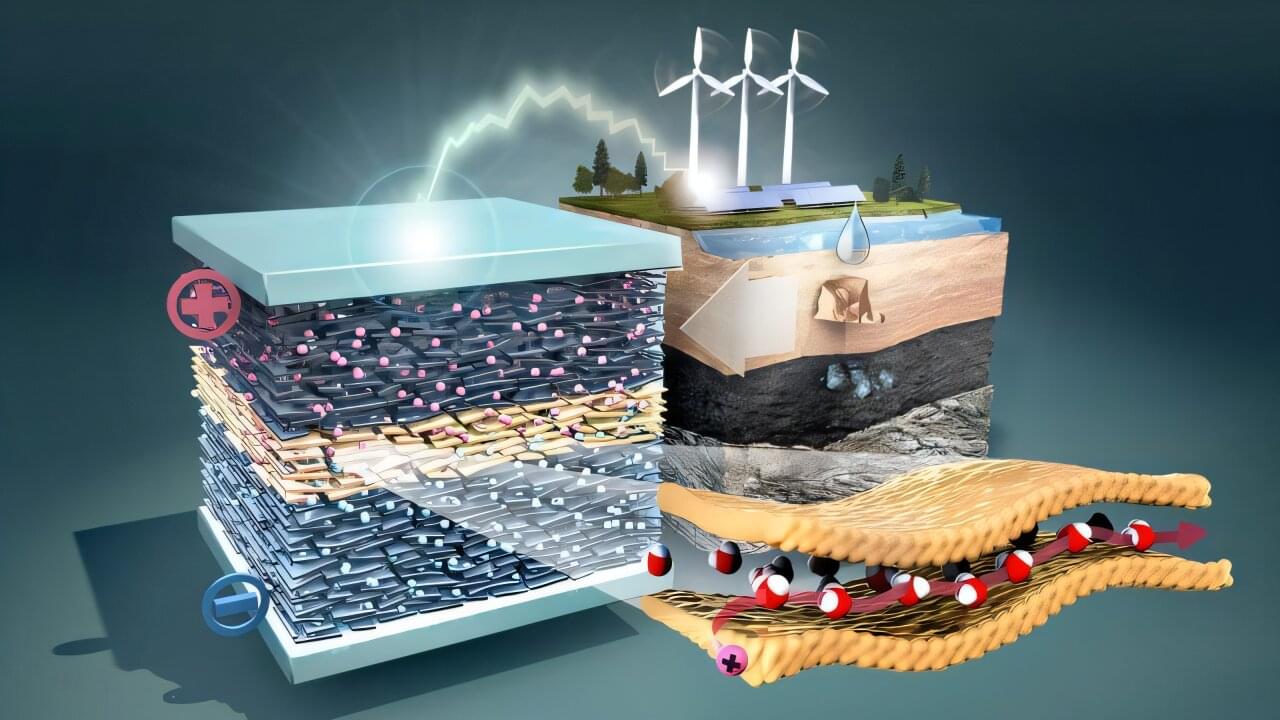
Can pure water store electrical energy? A research team led by Dr. Vasily Artemov within the Cluster of Excellence “BlueMat—Water-Driven Materials” at Hamburg University of Technology has now shown that it can. By confining water within nanometer-sized channels in clay minerals, the researchers created a supercapacitor capable of efficiently storing and transporting electrical charge.
What makes the finding unusual is that it uses pure water as its electrolyte—the medium that transports electrical charge. Today’s batteries and supercapacitors typically rely on added salts, acids, or other chemical electrolytes. In contrast, the new system works without such additives and is based solely on abundant, naturally occurring materials: water, clay, and carbon.
“Our goal is to develop safer and more sustainable energy-storage technologies based on abundant materials rather than complex chemical compounds,” says Artemov, lead author of the paper published in Nature Communications. “The device stores and releases energy efficiently, operates at a comparatively high voltage for a water-based system, and remains stable over tens of thousands of charging cycles.”