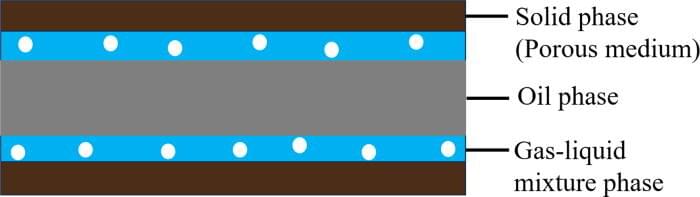
Ultrasound-based irradiation of rock formations has attracted considerable attention as a technique for enhancing heavy-oil (high-viscosity crude oil) recovery from deep underground reservoirs. However, a unified theoretical framework for wave propagation and energy dissipation in these formations remains lacking because water coexists with heavy oil within rock pores, and gas bubbles in the water respond dynamically to ultrasonic excitation, thereby creating a complex system.
Conventional theories typically treat oil as a purely viscous (Newtonian) fluid or assume frequency ranges markedly below the ultrasonic regime. Consequently, these theories inadequately capture oil viscoelasticity and the influence of bubble oscillations in the ultrasonic regime.
Researchers at University of Tsukuba have developed a theoretical framework to clarify the propagation of ultrasonic waves through complex materials such as rocks containing mixtures of oil, water, and gas bubbles. The work extends previous low-frequency models and constructs a theoretical framework applicable to ultrasonic frequencies by incorporating three notable elements into a unified system of equations: (i) heavy-oil viscoelasticity, (ii) dynamic capillary pressure at fluid-fluid interfaces, and (iii) oscillations of gas bubbles dispersed in water induced by ultrasonic pressure fluctuations.