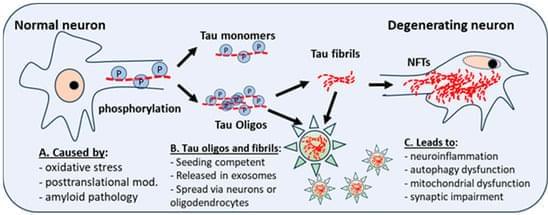
Background: Individuals with Down syndrome (DS) exhibit an almost complete penetrance of Alzheimer’s disease (AD) pathology but are underrepresented in clinical trials for AD. The Tau protein is associated with microtubule function in the neuron and is crucial for normal axonal transport. In several different neurodegenerative disorders, Tau misfolding leads to hyper-phosphorylation of Tau (p-Tau), which may seed pathology to bystander cells and spread. This review is focused on current findings regarding p-Tau and its potential to seed pathology as a “prion-like” spreader. It also considers the consequences of p-Tau pathology leading to AD, particularly in individuals with Down syndrome. Methods: Scopus (SC) and PubMed (PM) were searched in English using keywords “tau AND seeding AND brain AND down syndrome”