In 2003, physicists detected a particle known as the Ds(2317) meson, containing one charm quark and one strange antiquark. That discovery garnered significant attention because of a large discrepancy between the particle’s measured mass (2.317 GeV/c2) and its predicted mass (above 2.4 GeV/c2). Now the Belle and Belle II Collaboration has observed a previously unseen light-emitting decay of the particle [1]. The team’s analysis could help researchers solve the mass puzzle and help them investigate the fundamental forces that bind matter.
To explain the mass discrepancy, scientists have proposed several models for the particle’s internal structure. Each model predicts a specific range of possible values for the probability that the particle will decay by emitting a gamma ray divided by the probability that it will instead emit a pion. If the measured value of this ratio turns out to be above 8.1%, it would favor models in which the meson is a compact quark–antiquark state. Meanwhile, a ratio between 0.5% and 4.25% would align more closely with models in which the particle is an extended state that acts as a “molecule” of two mesons.
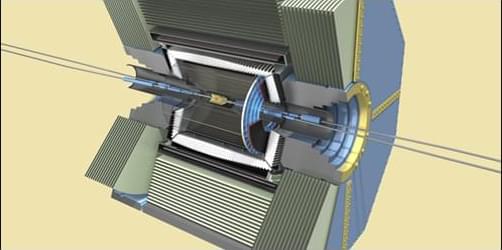
Using data from Japan’s KEKB and SuperKEKB electron–positron colliders, the Belle and Belle II Collaboration detected the particle’s gamma-emitting decay at a statistical significance above 10 standard deviations. The team measured the photon-to-pion decay ratio to be about 7%, smaller than that predicted by most quark–antiquark models but larger than that predicted by most molecular models. The researchers anticipate that pinning down the meson’s structure could entail measuring the particle’s total decay rate.