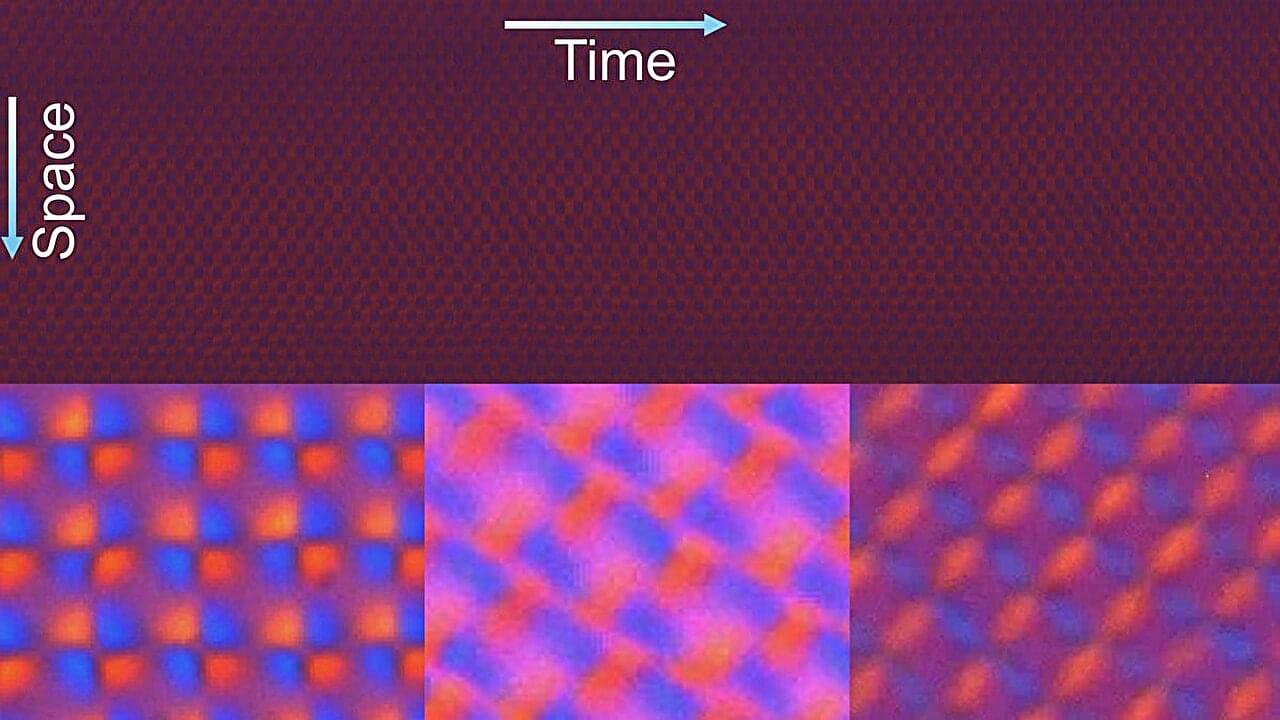
A research team from Hiroshima University, the University of Colorado, and other collaborators have demonstrated that space-time crystals—exotic structures that, under external drive, loop endlessly through both space and time—can be created using everyday liquid-crystal materials.
For the past decade, physicists have been fascinated by time crystals. Unlike normal crystals (such as salt or diamonds), which have repeating molecular patterns in space, time crystals have patterns that repeat at regular intervals in time. Previously, scientists believed these bizarre structures could exist only in highly complex, fragile quantum systems at near-absolute-zero temperatures, such as trapped ions or quantum simulators. However, in a collaborative study published in Nature Communications, researchers successfully created them in a classical, room-temperature liquid-crystal system.
To achieve this, the team took a liquid-crystal material—similar to the fluid used in smartphones and television screens—and doped it with ionic substances. They then applied a rhythmic, repeating electrical signal to the fluid. Using advanced computer models and optical microscopes, the researchers observed a surprising phenomenon known as period-doubling. Even though the electrical drive pumped energy into the fluid at a set internal rhythm, the liquid crystals spontaneously locked into a pattern that repeated only every two cycles of the electricity.