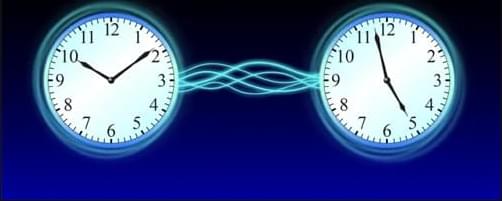
The synchronization of two quantum oscillators reveals a collective rhythm encoded solely in their correlations.
When clocks share a wall, heart cells pulse in a dish, or fireflies flash in a summer field, separate rhythms can somehow become one. Physicists call this phenomenon synchronization. It is familiar in the everyday world but becomes slippery in the quantum world, where an oscillator’s phase can be smeared out by environmental fluctuations and disturbed by measurements. Now, in a trapped-ion experiment, Jiarui Liu at the University of California, Berkeley, and his colleagues have observed synchronization between two quantum oscillators [1]. Their demonstration is important not just because it realizes a long-sought quantum version of a textbook nonlinear system, but also because the shared rhythm is hidden: Each oscillator alone shows no phase preference, and the beat emerges only when the two are measured together.
The classical picture of synchronization predates quantum mechanics. A key component is a self-sustained oscillator, a system that keeps repeating the same motion on its own. Such a system continually replaces the energy it loses through damping, while also preventing its motion from growing uncontrollably. Its amplitude is fixed, but its phase remains free, allowing an interaction with another oscillator to lock the two rhythms together.