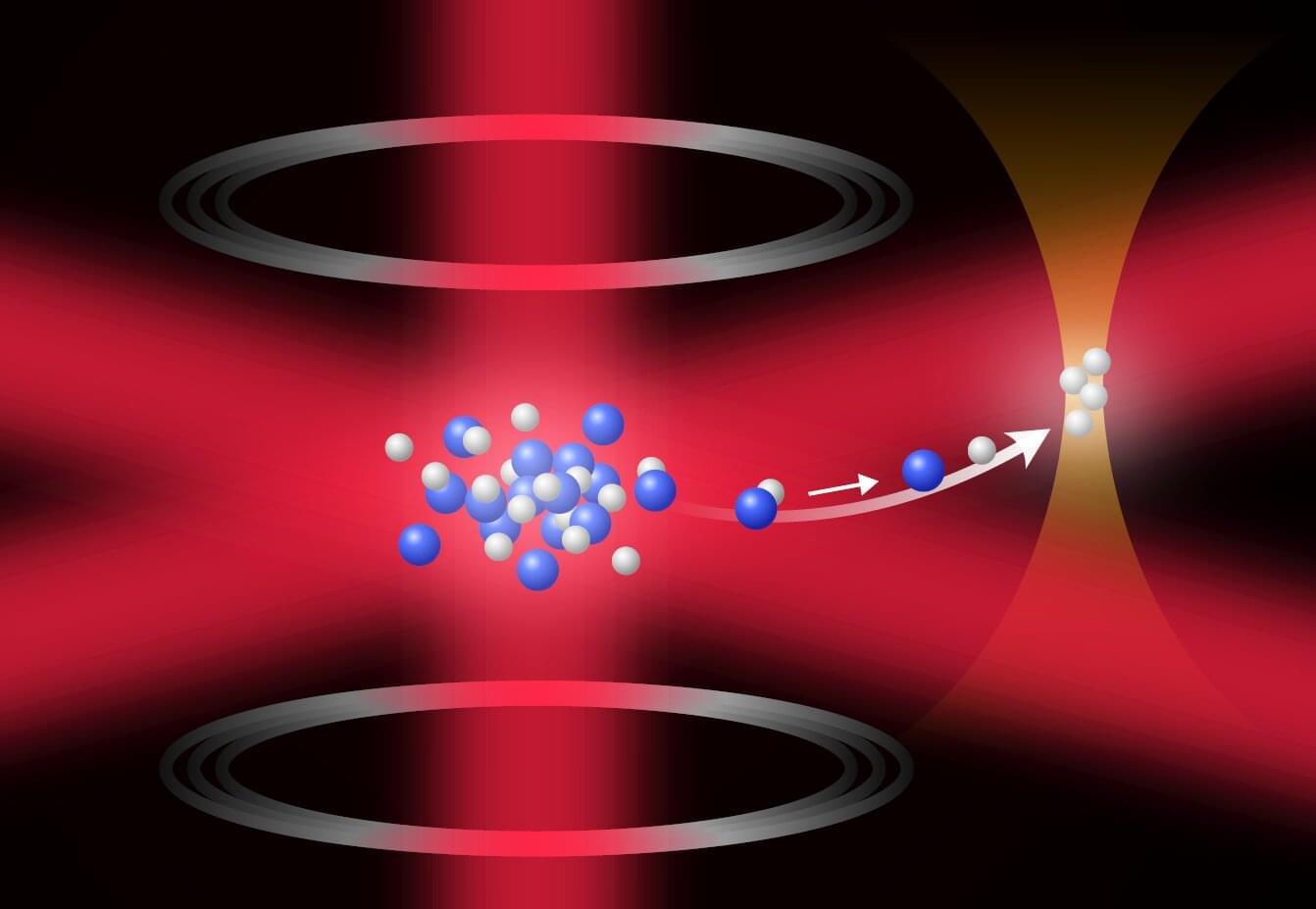
Controlling and trapping molecules, units of a substance consisting of two or more chemically bound atoms, with laser light is significantly more challenging than trapping individual atoms. This is because molecules exhibit more complex vibrational and rotational dynamics that make them more difficult to cool and trap.
In a paper published in Physical Review Letters, researchers at Columbia University and Indiana University Bloomington reported the effective cooling and trapping of calcium monohydride (CaH), a molecule consisting of a calcium atom and a hydrogen atom bound together.
This was achieved using a three-dimensional (3D) magneto-optical trap (MOT), a device that uses carefully arranged laser beams and magnetic fields to cool and confine particles.