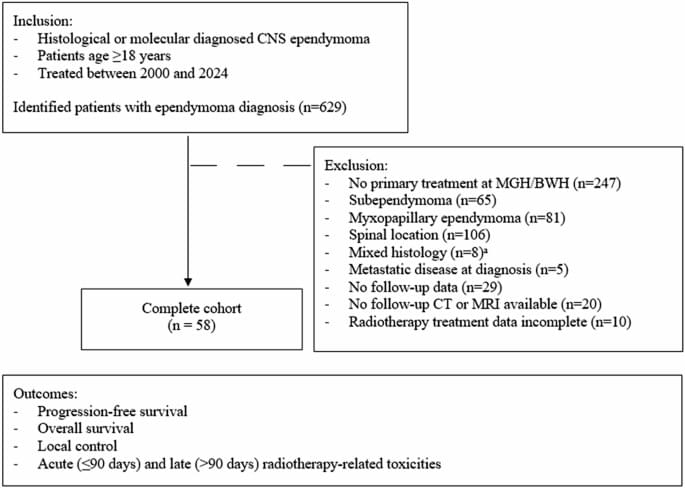
To evaluate progression-free survival (PFS), overall survival (OS), local control (LC), and radiotherapy-related toxicities in the treatment of adult intracranial ependymoma.
A retrospective analysis was performed of WHO grade 2–3 adult intracranial ependymoma patients (≥ 18 years) treated with surgery alone or surgery and adjuvant radiotherapy between 2000 and 2024. Kaplan-Meier analyses were used to estimate PFS and OS. Acute and late treatment-related toxicities were characterized.
Fifty-eight patients met the inclusion criteria. Median age was 39 years (interquartile range [IQR] 25–51), and median follow-up was 51 months (IQR 23–103). Overall, 76% were WHO grade 2, 74% had posterior fossa location, gross total resection was achieved in 60%, 88% received adjuvant local radiotherapy, and 5% received adjuvant chemotherapy. Five and 10-year PFS rates were 80% and 64%, respectively; 5 and 10-year OS rates were 92% and 85%, respectively. There were 13 (22%) recurrences: The location of first failure was local in nine, distant in two, and both local and distant in two. The 5-year LC rate was 82% (95% CI 67–90%), and the 10-year LC rate was 72% (95% CI 53–84%). The median time to local failure was 5.4 years. Ten (22%) patients experienced at least one grade ≥ 2 late treatment-related toxicity. One potential secondary glioma (grade 5) occurred after nine years.