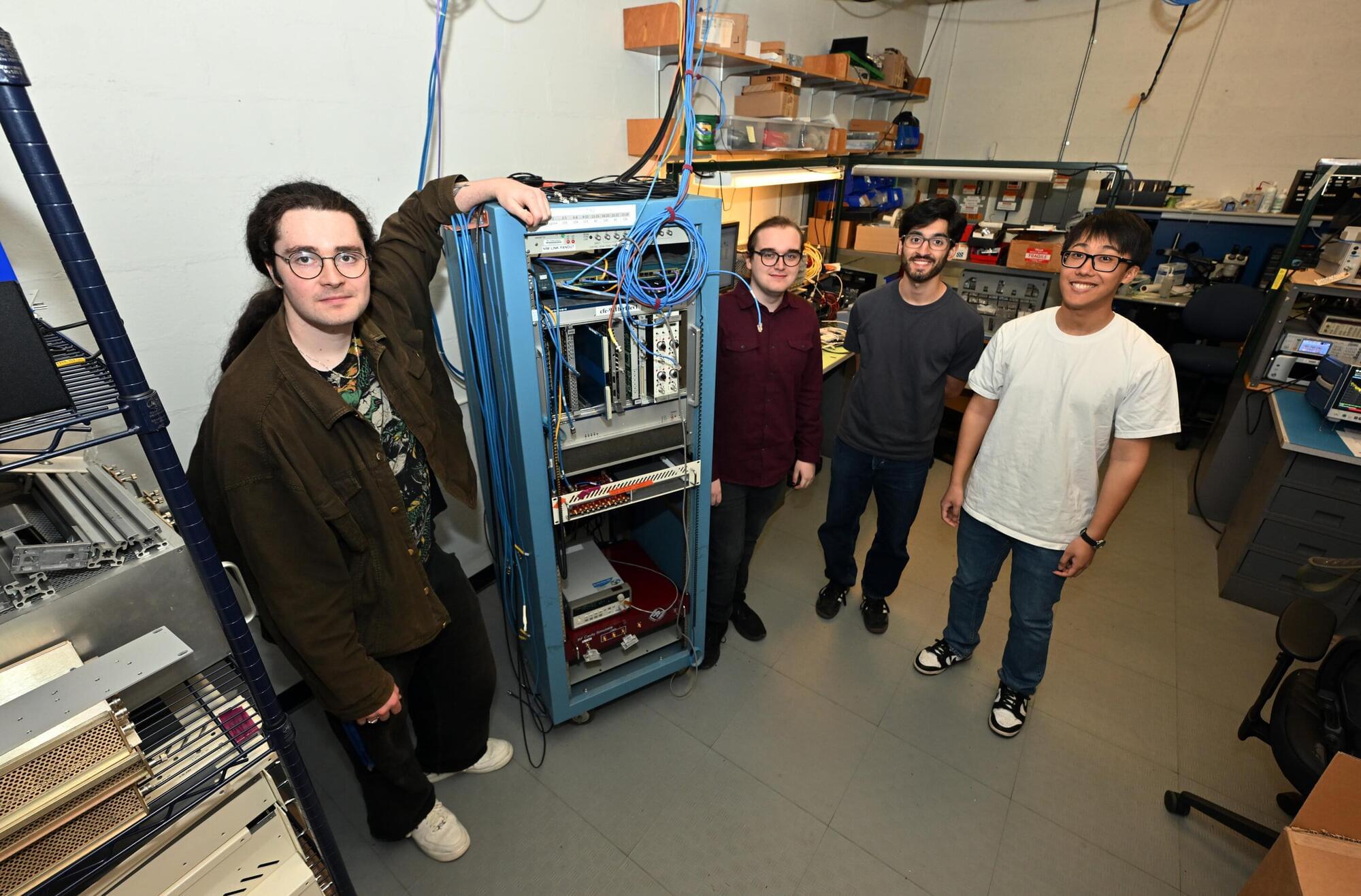
The U.S. Department of Energy’s (DOE) Brookhaven National Laboratory has reached a key early milestone in developing radiofrequency control systems for the Electron-Ion Collider (EIC)—a next-generation research facility that will collide electrons with ions to reveal how the building blocks of matter are held together.
At the heart of any particle accelerator are radiofrequency (RF) systems, which use electromagnetic waves to accelerate particle beams to near-light speed and keep them tightly controlled. The system tested here—known as low-level radiofrequency (LLRF)—acts as the “brain,” precisely controlling those RF fields to ensure stable and accurate operation.
This milestone marks the first successful test of the newly built EIC common platform-based LLRF electronics on a real accelerator cavity. The common platform is a shared hardware and control system for accelerator operations, allowing teams to use the same technology rather than create separate electronics for each system.