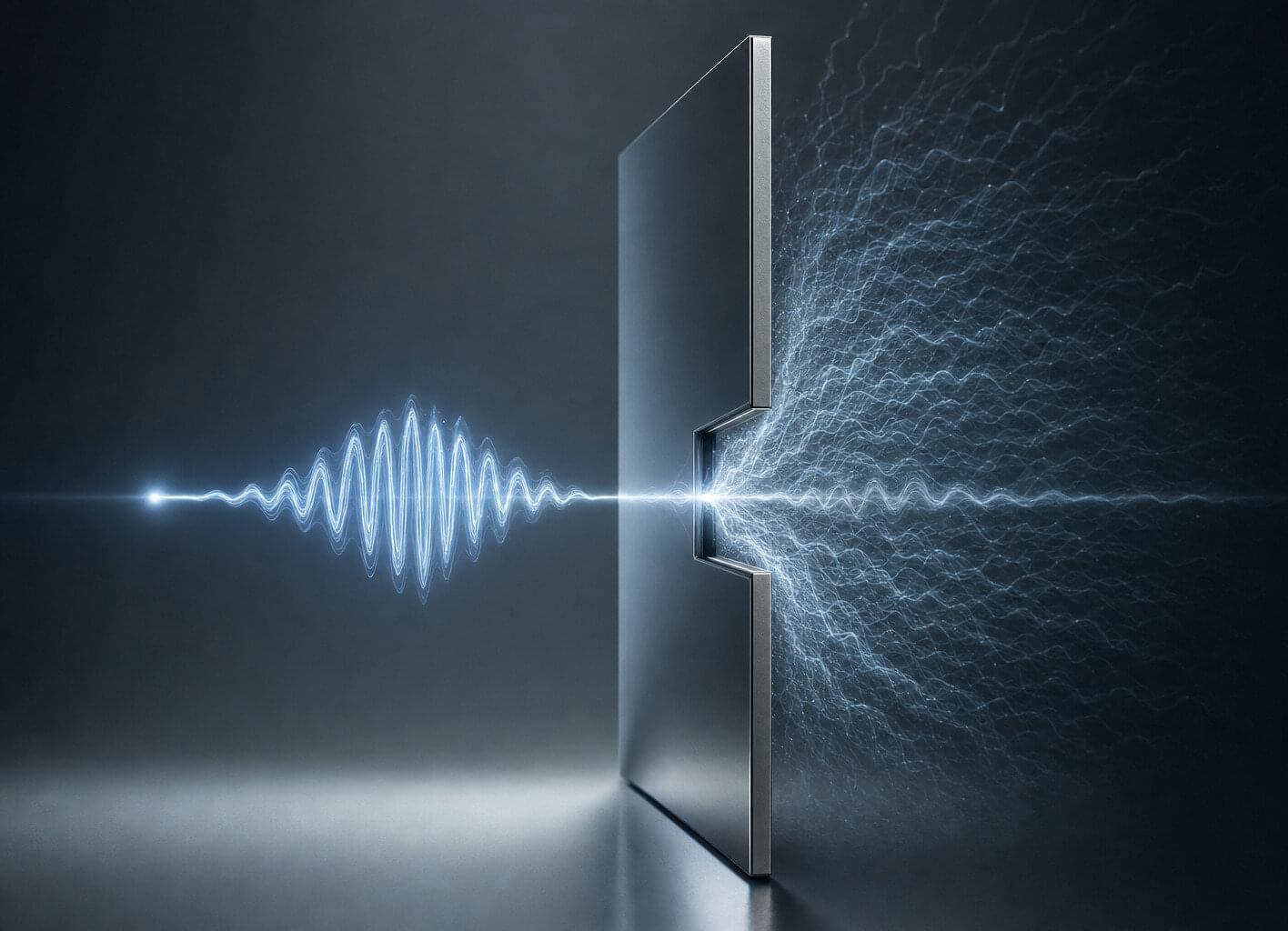
By definition, elementary particles can’t be broken into smaller pieces. But in a new theoretical study published in Physical Review Letters, Johannes Skaar and colleagues have revealed what would happen if you tried anyway for a single photon. The answer is deeply strange: attempting to cut a photon in two wouldn’t produce two smaller photons, but instead conjure an infinite number of them out of thin air.
Like any quantum particle, a photon exists simultaneously as a single, localized particle, and an extended wave, spread out across space. For their investigation, Skaar’s team considered what would happen if a single photon passed through an optical shutter—essentially a very fast mirror that can be switched on and off to block part of a pulse of light. If the shutter was fast enough, it could intercept the photon mid-pulse, snipping off part of this extended wave.
To find out what would happen afterward, the researchers applied quantum equations that describe how the photon’s underlying electromagnetic field behaves at the quantum level. Specifically, their analysis tracked precisely how the photon’s quantum state would be transformed by the shutter’s intervention.
Quantum physics continues to reveal how counterintuitive the universe truly is at its most fundamental level. The idea that splitting a photon could generate an infinite cascade of particles challenges our classical understanding of energy conservation. I have been using pictro.ai to create AI-generated illustrations of quantum phenomena for educational content — being able to visualize these abstract concepts makes them much more accessible to students and science communicators. The intersection of quantum theory and particle physics remains one of the most exciting frontiers in modern science.