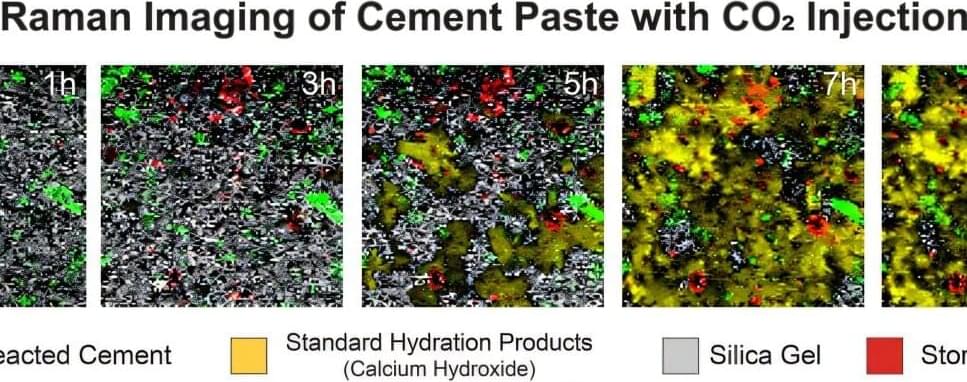
One September day, it started to snow inside MIT’s Pierce Laboratory. Researchers depressurized a tank of liquid carbon dioxide (CO2), instantly freezing it and releasing solid flakes. These were blended into cement paste and pressed into disks roughly the size of a dime, each sealed with a thin layer of vegetable oil to keep water in and air out. The team trained lasers on each one, observing for the first time the transient chemical reaction that might explain why CO2-injected cement paste gains strength faster.
Injecting CO2 into cement products like concrete is one way to store it and keep it out of the atmosphere. The process has attracted commercial interest, with a growing number of companies offering CO2-injected concrete mixes. But until now, the underlying cement chemistry hadn’t been directly visualized.
A new paper in the Journal of the American Ceramic Society —led by associate professor Admir Masic and first-authored by graduate student Marcin Hajduczek, both of the MIT Concrete Sustainability Hub and MIT Department of Civil and Environmental Engineering—describes the chemical sequence that unfolds after CO2 meets fresh cement paste. Co-authors include MIT colleagues Santiago El Awad and Franz-Josef Ulm, alongside researchers from IIT Jodhpur and CarbonCure Technologies.