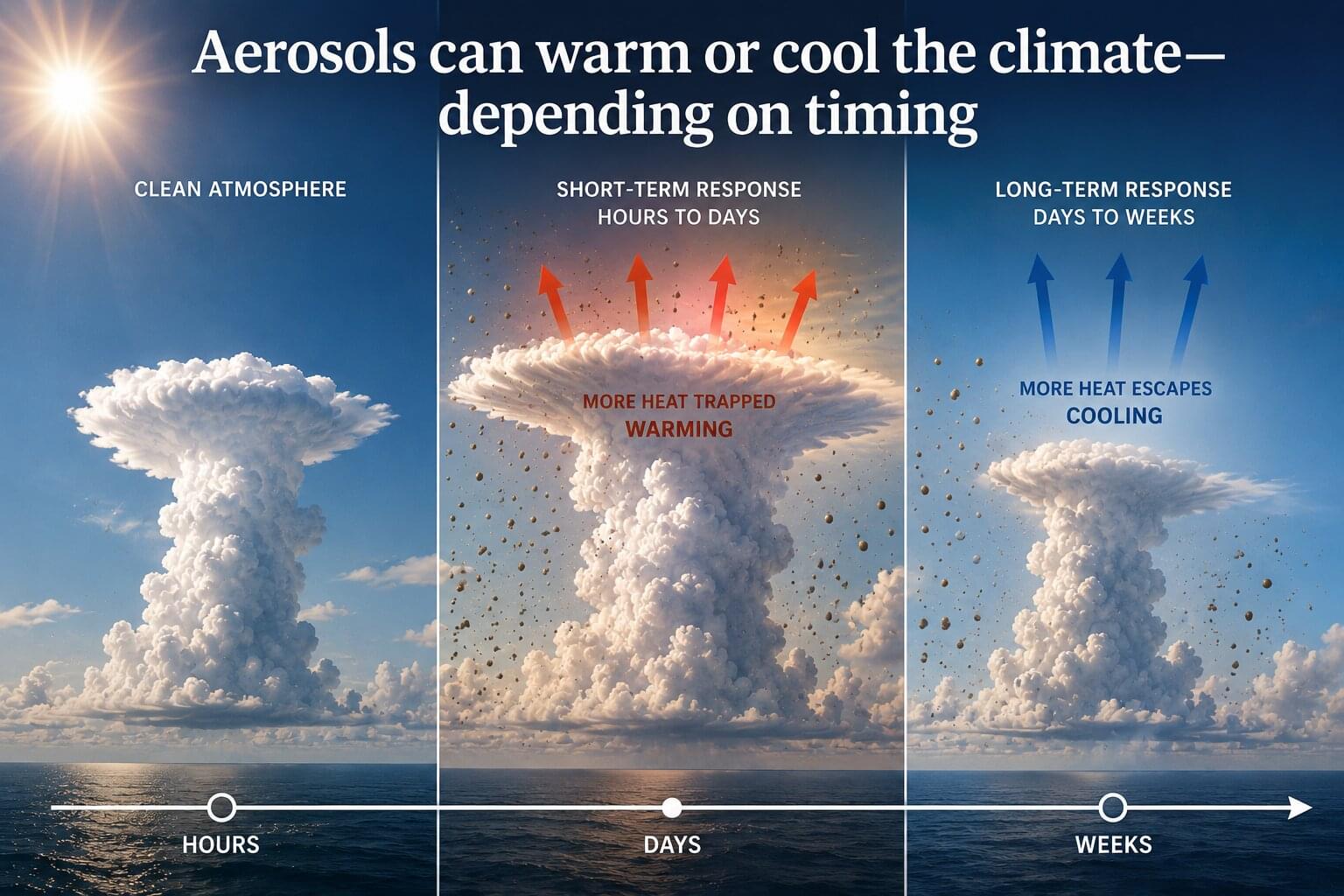
A new study from the Hebrew University of Jerusalem challenges a long-held assumption in climate science by showing that aerosols—tiny particles suspended in the atmosphere—can either warm or cool the climate, depending on the time scale considered.
Led by Prof. Guy Dagan of the Fredy and Nadine Herrmann Institute of Earth Sciences, the research reveals that aerosol-cloud interactions can produce opposite climate effects in the short and long term. The findings, published in Nature Communications, offer a new explanation for why aerosols remain one of the largest sources of uncertainty in climate projections.
Aerosols come from a variety of natural and human-made sources, including air pollution, wildfires, sea spray and dust. Scientists have long known that these particles influence how clouds form and how much heat Earth retains, but accurately estimating their overall impact on climate has proved difficult.