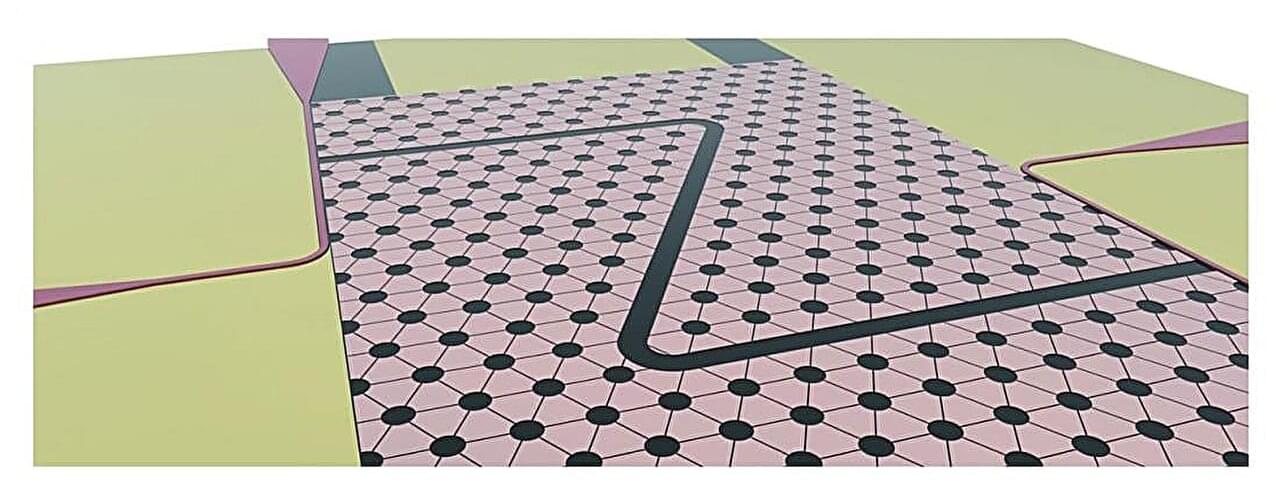
A research team from Tohoku University, Shin-Etsu Chemical Co., Ltd., and École Polytechnique Fédérale de Lausanne (EPFL) has invented a new way to efficiently guide spin waves around sharp corners with minimal loss—representing an exciting discovery for energy-efficient computing. Using a two-dimensional magnonic crystal—a copper (Cu) film with a hexagonal array of tiny holes placed on a magnetic garnet film—the team showed through calculations that spin waves travel along a Z-shaped path more than 5,000 times more efficiently than in conventional waveguides.
As artificial intelligence and data centers consume ever more electricity, heat from conventional electronics has become a serious problem. Spin waves are ripples of magnetization in a magnetic material that can carry information with far less heat than moving electrons, making them promising for reduced-energy computing. However, spin waves weaken quickly as they travel, especially when a waveguide is bent. This signal loss has long been the biggest obstacle to building practical spin wave circuits.