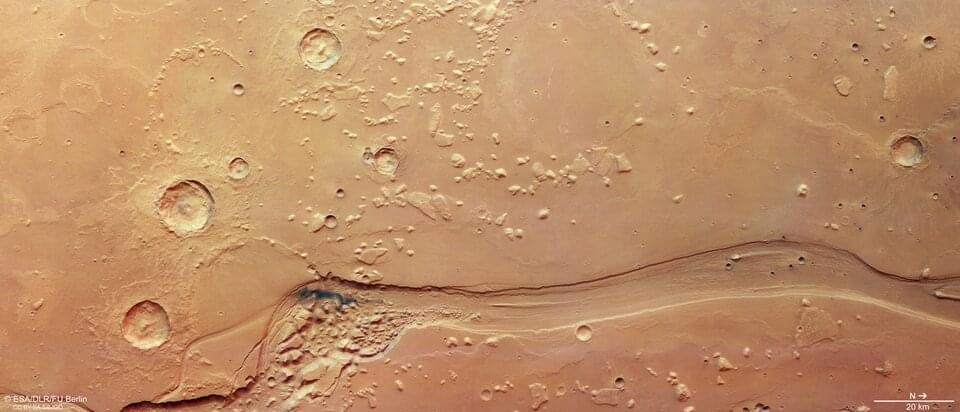
New images of Shalbatana Vallis from ESA’s Mars Express orbiter reveal well-preserved geological clues of past water and lava activity on ancient Mars. [ https://www.labroots.com/trending/space/30564/ancient-martia…st-ocean-2](https://www.labroots.com/trending/space/30564/ancient-martia…st-ocean-2)
How much water and lava flowed across the surface of Mars billions of years ago? This is what a recent image obtained from the European Space Agency’s Mars Express orbiter hopes to figure out as the more than two-decade-old orbiter captured incredible images that could help researchers piece together the environment on ancient Mars. This is because these images offer clues of past water and lava activity on Mars when the Red Planet was far warmer and wetter than it is today.
This latest image reveals a vast area comprised of a mixture of buried and visible impact craters, eroded hills and mesas, wrinkle ridges from lava cooling and contracting, chaotic terrain from the melting of ice, dark volcanic ash, and a massive channel called Shalbatana Vallis where researchers hypothesize was craved from massive amounts of groundwater that swelled up to the Martian surface. Because Mars lack plate tectonics like Earth, these landforms have been well-preserved for billions of years. Once Mars became incapable of having liquid water on its surface, the Martian wind and dust buried and eroded some of these features, though not to the extent as we see erosion on Earth.